TL;DR
Switching to a tankless electric water heater is a major decision that depends almost entirely on your local climate and your electrical panel’s capacity. For most whole-house applications, the Stiebel Eltron Tempra 36 Plus is the gold standard because it manages water flow to prevent cold shocks. However, these units demand massive amounts of power—often requiring up to 150 amps of dedicated service. In warmer southern climates, smaller units like the EcoSmart ECO 27 perform beautifully, but in northern regions where groundwater is icy, electric tankless units often struggle to provide enough hot water for more than one shower at a time. If your home cannot handle a significant electrical upgrade, a hybrid heat pump water heater is often a more practical and energy-efficient alternative.
You are standing in your utility closet, looking at a bulky, aging water tank and wondering if there is a better way. The promise of “endless hot water” from a unit the size of a suitcase is incredibly tempting. As we move toward more sustainable, all-electric homes, many homeowners are looking at tankless electric options as a space-saving, modern solution. But before you pull the trigger on a purchase, you need to know that electric tankless technology isn’t a “one size fits all” upgrade. It is a specialized piece of equipment that requires a specific set of conditions to actually work as promised.
In my years helping homeowners navigate water heating systems, I’ve seen people fall in love with the extra closet space, only to realize their lights flicker every time someone starts a shower. This guide is here to help you avoid those expensive mistakes. We will look at the best models available in 2026, but more importantly, we’ll look at whether your home’s infrastructure can actually support them.
What Real Users Are Saying (Reddit Insights)
The marketing brochures for tankless heaters often promise massive flow rates, but real-world users on platforms like Reddit tell a more nuanced story. To get the truth, you have to look at where these people live and how their homes are wired.
User Sentiments: When Electric Actually Works
There is a clear divide in user satisfaction based on geography. In southern climates, like Florida or Texas, users report high satisfaction. When your groundwater enters the home at 70°F or higher, the heating elements don’t have to work nearly as hard to reach a comfortable 120°F. For these users, a mid-sized unit provides truly endless hot water for multiple showers simultaneously.
“I live in S Florida. Been using electric tankless for over 10 years. Love it… It does take a solid minute to heat the water so you turn it on and let it run – but it’s the way to go down here.” — r/askaplumber
Users also frequently praise these units for “niche” applications. For a small cottage, a tiny guest house, or a remote office, the space-saving benefits are hard to beat. If you only need to support one sink and one shower, the complexity of the installation drops significantly.
Cons & Complaints: The ‘Electric Trap’
The most common warning from professional plumbers and electricians involves the “insane” power draw. Unlike a gas tankless unit that uses a flame to flash-heat water, electric units rely on massive resistance coils. This requires multiple high-amp circuits that many older homes simply don’t have. Many users have found themselves facing a $3,000 electrical panel upgrade just to install a $700 water heater.
“Electric tankless water heaters for a whole house use too much electricity. I installed one once. I uninstalled it the next day. It required three dedicated 50A circuits. Most houses around here only have 250A meters.” — r/Plumbing
The other major complaint is the “sandwich effect”—that burst of cold water you get if you turn the hot water off and then back on quickly. While higher-end models mitigate this, budget units often struggle with temperature consistency when groundwater temperatures dip below 50°F in the winter.
Budget Tips & Value Picks
The consensus among the DIY community is that if you have hard water, you must factor in the cost of a scale inhibitor or a water softener. Without it, the heating elements in an electric tankless unit can fail in as little as two years. Many budget-conscious users recommend the EcoSmart series for warm climates, but emphasize that the “lifetime warranty” often requires professional installation receipts to be valid.
Top-Rated Electric Tankless Water Heaters
When selecting a unit, you aren’t just looking at the price tag; you’re looking at the “Delta T”—the temperature rise the unit can achieve at a specific flow rate. Here are the models that consistently rise to the top of the pack for reliability and performance.
Best Overall: Stiebel Eltron Tempra 36 Plus
The Stiebel Eltron Tempra 36 Plus is widely considered the king of the category. What sets it apart is its “Advanced Flow Control.” If the demand for hot water exceeds what the heating elements can handle, the unit slightly reduces the water flow to ensure the temperature stays constant. This prevents the dreaded “cold shower” if someone accidentally starts the dishwasher while you’re bathing.
In practice, the Tempra 36 Plus feels much more like a traditional tank in terms of reliability. It features a digital display that allows you to set the exact temperature you want. However, you must be prepared for the electrical requirements. This unit pulls a massive amount of power and usually requires three 60-amp breakers. If your home has 100-amp or even 200-amp service, you might be pushing your panel to its absolute limit.
The Good
- Advanced Flow Control maintains steady temperatures even if flow exceeds capacity.
- Solid German engineering with a very low failure rate compared to budget brands.
- Quiet operation with no clicking or buzzing sounds during high demand.
The Bad
- Requires 300 amps of total home service for safe operation in many configurations.
- One of the most expensive electric units on the market.
- The internal components are packed tightly, making DIY repairs difficult for beginners.
Should You Buy? Best for large families in moderate climates who want the most reliable experience possible. Skip if your electrical panel is already full or under 200 amps.
Best for Small Apartments/Cottages: Rheem RTEX-13
If you are looking to provide hot water for a single point of use—like a studio apartment or a backyard “she-shed”—the Rheem RTEX-13 is a practical, compact choice. It’s designed to handle about 3.17 GPM, which is enough for one low-flow showerhead and a sink in a warm climate. In colder areas, expect it to handle just one fixture at a time.
The RTEX-13 is much easier to install than its larger siblings. It only requires a single 60-amp double-pole breaker, which most modern electrical panels can accommodate without a total service upgrade. It’s a “set it and forget it” unit that hides away under a sink or in a small closet, making it one of the better electric kitchen appliances for remote kitchenettes.
The Good
- Simple installation that doesn’t usually require a panel upgrade.
- External digital thermostatic control is easy to read and adjust.
- Very affordable entry point for tankless technology.
The Bad
- Not a whole-house solution; it will struggle with more than one fixture.
- In northern winters, the flow rate can drop to 1.0 GPM, which is barely a trickle.
- The plastic fittings can be prone to leaking if over-tightened during install.
Should You Buy? Best for single-occupant dwellings or supplemental hot water for a distant bathroom. Skip if you have a family of four or live in a very cold climate.
Best High-Capacity Value: Rheem RTEX-36
Rheem’s RTEX-36 is the direct competitor to the Stiebel Eltron 36. It offers a higher maximum flow rate on paper (up to 8.8 GPM), making it look like a powerhouse for large homes. It uses four copper immersion heating elements that are designed to be easily replaceable, which is a big plus for long-term maintenance.
While it lacks the sophisticated flow modulation of the Stiebel Eltron, it provides raw heating power at a slightly lower price point. If you have a large household with high demand but your incoming water isn’t freezing cold, the RTEX-36 is a workhorse. Just be aware that it requires four 40-amp breakers, which can turn your electrical panel into a chaotic mess of wires if not handled by a pro.
The Good
- Exceptional heating capacity for the price.
- Heating elements are threaded for easy removal and descaling.
- Compact design for a unit with this much power.
The Bad
- Does not prioritize temperature over flow; if you open too many taps, the water gets cold.
- The “99% efficiency” claim is standard for electric, but doesn’t account for the high cost of electricity in some states.
- Requires a massive 150-amp dedicated load.
Should You Buy? Best for large households on a budget who have the electrical headroom. Skip if you want “smart” features or flow-prioritization.
Best for Warm Climates: EcoSmart ECO 27
The EcoSmart ECO 27 is perhaps the most famous tankless electric unit, largely because it’s a staple in southern retail stores. It’s a “Goldilocks” unit—not too small, not too large. In regions where groundwater stays above 65°F, this unit can comfortably run two showers and a sink simultaneously without breaking a sweat.
However, the ECO 27 has a reputation for being sensitive to hard water. Homeowners in places like Arizona or Florida often report the heating elements burning out if they don’t perform annual vinegar flushes. If you’re diligent about maintenance, this unit provides excellent value and is frequently available at a lower price than the premium brands.
The Good
- Compact size is perfect for replacing a 40-50 gallon tank in a tight closet.
- Quick response time; hot water reaches the tap faster than some larger units.
- Widely available parts at most hardware stores.
The Bad
- Warranty is notoriously difficult to claim without proof of professional installation.
- Poor performance in climates where groundwater drops below 50°F.
- Standard copper elements scale up quickly in hard water areas.
Should You Buy? Best for southern homeowners who want a proven, popular model and are okay with regular maintenance. Skip if you live north of the Mason-Dixon line.
Mid-Range Reliable: Stiebel Eltron Tempra 24 & 29
For homes that can’t quite handle the 150-amp draw of the 36 Plus, the Tempra 24 and 29 models offer a great middle ground. These units use the same “Plus” technology (Advanced Flow Control) but at a lower power draw. The Tempra 24 is often the “sweet spot” for 1-bathroom homes, requiring only 100 amps of dedicated service.
I often recommend these to people living in older bungalows where a full 300-amp service upgrade isn’t feasible. They provide the same temperature stability as the flagship model, just at a lower total volume. If you’re looking for a best tankless water heater experience without the extreme electrical stress, these are your best bet.
The Good
- Uses the same high-end flow control as the more expensive models.
- More manageable electrical requirements (100A to 120A).
- Very consistent temperature output.
The Bad
- Will significantly reduce water flow if two showers are running in a cold climate.
- Price is still high for the amount of hot water produced.
- Minimalist interface might be too simple for tech-lovers.
Should You Buy? Best for 1-2 bathroom homes that want quality over quantity. Skip if you frequently run the shower, laundry, and dishwasher at the same time.
Comparison Table: Best Tankless Electric Water Heaters
| Product Name | Best For | Price Range | Pros/Cons | Visit |
|---|---|---|---|---|
| Stiebel Eltron Tempra 36 Plus | large families in moderate climates who want the most reliable experience pos… | Check price on Amazon | ✅ Advanced Flow Control maintains steady temperature; Solid German engineering with a very low failure r ❌ Requires 300 amps of total home service for safe o; One of the most expensive electric units on the ma |
|
| Rheem RTEX-13 | single-occupant dwellings or supplemental hot water for a distant bathroom | Check price on Amazon | ✅ Simple installation that doesn’t usually require a; External digital thermostatic control is easy to r ❌ Not a whole-house solution; it will struggle with ; In northern winters, the flow rate can drop to 1.0 |
|
| Rheem RTEX-36 | large households on a budget who have the electrical headroom | Check price on Amazon | ✅ Exceptional heating capacity for the price.; Heating elements are threaded for easy removal and ❌ Does not prioritize temperature over flow; if you ; The “99% efficiency” claim is standard for electri |
|
| EcoSmart ECO 27 | southern homeowners who want a proven, popular model and are okay with regula… | Check price on Amazon | ✅ Compact size is perfect for replacing a 40-50 gall; Quick response time; hot water reaches the tap fas ❌ Warranty is notoriously difficult to claim without; Poor performance in climates where groundwater dro |
|
| Stiebel Eltron Tempra 24 & 29 | 1-2 bathroom homes that want quality over quantity | Check price on Amazon | ✅ Uses the same high-end flow control as the more ex; More manageable electrical requirements (100A to 1 ❌ Will significantly reduce water flow if two shower; Price is still high for the amount of hot water pr |
Critical Infrastructure: Can Your Home Handle It?
Before you get excited about “endless” hot water, we have to talk about the physics of your house. There are two major roadblocks that stop most electric tankless installations in their tracks.
Ground Water Temperature vs. GPM Output
The biggest lie in water heater marketing is the Gallons Per Minute (GPM) rating. A manufacturer might say a unit provides 10 GPM, but that’s usually assuming your water is already 70°F and you only want it slightly warmer. In the northern United States or Canada, groundwater in winter can drop to 35°F or 40°F. To get that water to 120°F, the heater has to raise the temperature by 80 degrees. This “Delta T” is exhausting for electric elements. That 10 GPM unit can suddenly drop to 2.5 GPM, which is barely enough for one lukewarm shower. If you live in a cold climate, you effectively have to “oversize” your unit or accept that winter showers will be a solo activity.
Electrical Panel & Amperage Requirements
A standard 50-gallon tank water heater uses one 30-amp breaker. A whole-house tankless unit like the Stiebel Eltron 36 Plus uses three 60-amp breakers. That is 180 amps of dedicated potential draw. If your home has a 200-amp main service, and you turn on your electric oven, your AC kicks on, and someone starts a shower, you are at serious risk of tripping your main breaker. I’ve spoken to many homeowners who had to spend more on the electrician ($2,000–$5,000) than they did on the actual heater. If you have an older home with 100-amp service, tankless electric is simply not an option without a massive infrastructure upgrade.
The Best Alternatives When Electric Isn’t Feasible
If the electrical requirements for a tankless unit have you rethinking your plans, don’t worry. There are other ways to get high efficiency without rebuilding your home’s power grid.
The Efficiency King: A.O. Smith Voltex XE Hybrid Heat Pump
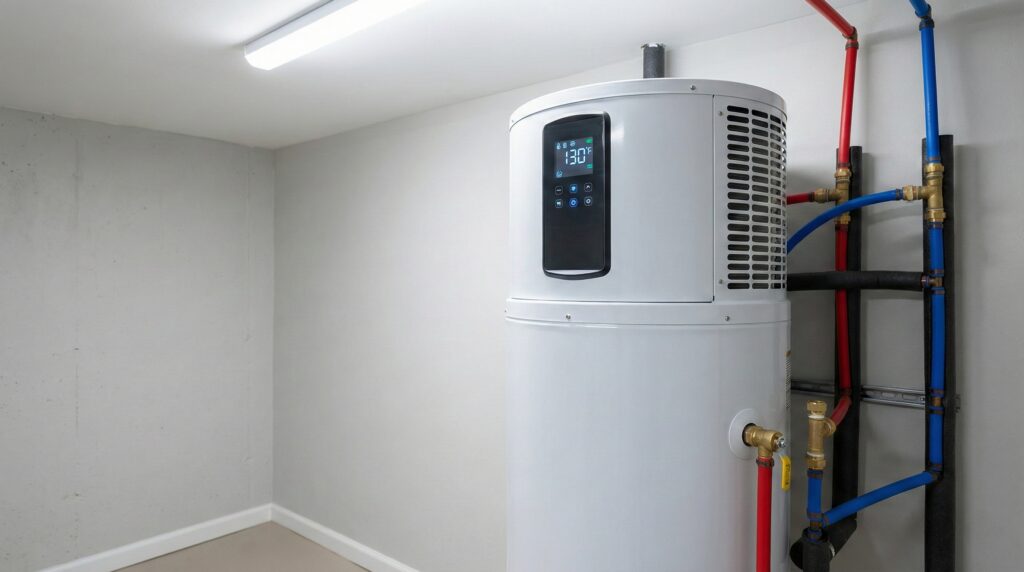
Plumbers often recommend hybrid heat pump water heaters over tankless units for homeowners who want to be energy-efficient. A hybrid unit like the A.O. Smith Voltex XE uses heat pump technology to pull heat from the surrounding air and move it into the water. It is up to 4 times more efficient than a standard electric tank and, crucially, it runs on a standard 30-amp breaker. It also provides dehumidification for your basement as a side benefit. While it’s still a tank and will eventually run out of water, the recovery rates are excellent, and the long-term energy savings are often higher than a tankless unit.
The Power of Gas: Rinnai RU180iN (Natural Gas)
If you have access to natural gas or propane, a gas tankless unit like the Rinnai RU180iN is objectively superior in performance to electric. Gas can ramp up its BTUs instantly to meet massive demand, even with freezing groundwater. While it requires venting and gas lines, it doesn’t put any stress on your electrical panel. For a large home in a cold climate, gas is almost always the more practical tankless choice.
Best Tankless Electric Water Heater by Segment
Best for Small Cottages
The Rheem RTEX-13 is the perfect companion for a getaway cabin or a remote guest house. Since these spaces usually have lower hot water demand and simpler electrical setups, the 13kW output is usually sufficient and won’t require a service upgrade.
Best for 1-Bathroom Homes
The Stiebel Eltron Tempra 24 provides the perfect balance. It delivers enough hot water for a continuous shower and a sink, but it only requires two 50-amp breakers, making it much more likely to fit into a standard 200-amp home panel than the larger models.
Best for Southern Climates (Florida/Texas)
The EcoSmart ECO 27 is the regional champion here. Because the groundwater is warm, this unit performs like a much more expensive heater. It’s affordable, easy to find, and widely understood by local plumbers in the south.
Frequently Asked Questions
Are electric tankless water heaters actually good for whole-house use?
They can be, but it depends on your climate. In warm states, a unit like the Stiebel Eltron Tempra 36 Plus can easily handle a whole house. In cold climates, they often struggle to support more than one major fixture at a time. They are most successful in homes with 300-amp electrical service and moderate hot water needs. For high-demand homes, they are often less practical than a best tankless water heater powered by gas.
Why do plumbers recommend Stiebel Eltron over other electric brands?
Plumbers prefer Stiebel Eltron because of their Advanced Flow Control technology. Most electric tankless heaters will simply let the water temperature drop if you open too many faucets. Stiebel units actually slow the water flow down slightly to ensure the temperature stays at your desired setting. This makes them much more reliable for families who don’t want to worry about “cold shocks” in the shower.
How many amps does an electric tankless water heater require?
A whole-house unit typically requires between 100 and 150 amps of dedicated power. For example, the Rheem RTEX-36 requires four 40-amp breakers. This usually means you need a 200-amp or 300-amp main electrical panel to safely run the heater along with your other heating and cooling solutions like an air conditioner or electric furnace.
Does ground water temperature affect tankless flow rate?
Yes, significantly. If your incoming water is 40°F (common in northern winters), the heater has to work twice as hard as it would for 70°F water. This reduces the amount of hot water the unit can produce per minute. A unit like the EcoSmart ECO 27 might provide 6 GPM in Florida but only 2.5 GPM in Maine during the winter.
Is an electric tankless heater or a hybrid heat pump more efficient for solar?
For solar setups, a hybrid heat pump like the A.O. Smith Voltex XE is generally better. It uses much less total energy and can be programmed to run during peak solar production hours. Tankless units have a massive, sudden power draw that can strain battery systems or exceed the instantaneous output of smaller solar inverters. If you’re looking for whole-home smart control, pairing a hybrid tank with a best smart thermostat is often the most efficient path.
Final Verdict: Which Tankless Electric Should You Buy?
If you have the electrical capacity and you live in a moderate climate, the Stiebel Eltron Tempra 36 Plus is the most reliable, “no-regrets” choice you can make. It manages the water flow better than any other unit, ensuring your morning shower isn’t ruined by someone else using the sink.
However, if you live in a cold climate or have a 100-amp electrical panel, I urge you to look at a hybrid heat pump tank instead. The installation will be cheaper, your electricity bills will be lower, and you won’t have to worry about your lights flickering when the hot water turns on. Electrifying your home is a marathon, not a sprint, and sometimes the best choice is the one that works with your home’s existing bones rather than fighting against them.
We may earn affiliate commissions from qualifying purchases. This doesn’t influence our reviews.