TL;DR
The best EV charger is the one that matches your car’s connector (NACS vs J1772) and your home’s electrical capacity — and is clearly safety-certified (UL/ETL) for continuous, high-current use. Most homeowners land in the 32A–48A range once a licensed electrician sizes the circuit correctly, so we’d focus less on “max amps” marketing and more on safe install type (hardwired vs plug-in), cable reach, and day-to-day reliability.
Top Recommended EV Chargers
| Product | Best For | Price | Pros/Cons | Visit |
|---|---|---|---|---|
| Tesla Wall Connector – Home Electric Vehicle (EV) Charger, | Tesla-first households wanting a clean, fast wall setup | Check price on Amazon | Fast Level 2 charging and strong customer experience; compatibility can be tricky outside intended vehicle/region | Visit Amazon |
| Grizzl-E Ultimate Level 2 80A 19.2 kW EV Charger | Higher-power installs with adjustable current limits | Check price on Amazon | Highly customizable current control for panel-constrained homes; some customer experience flags around connectivity/support | Visit Amazon |
Top Pick: Best Overall EV Charger
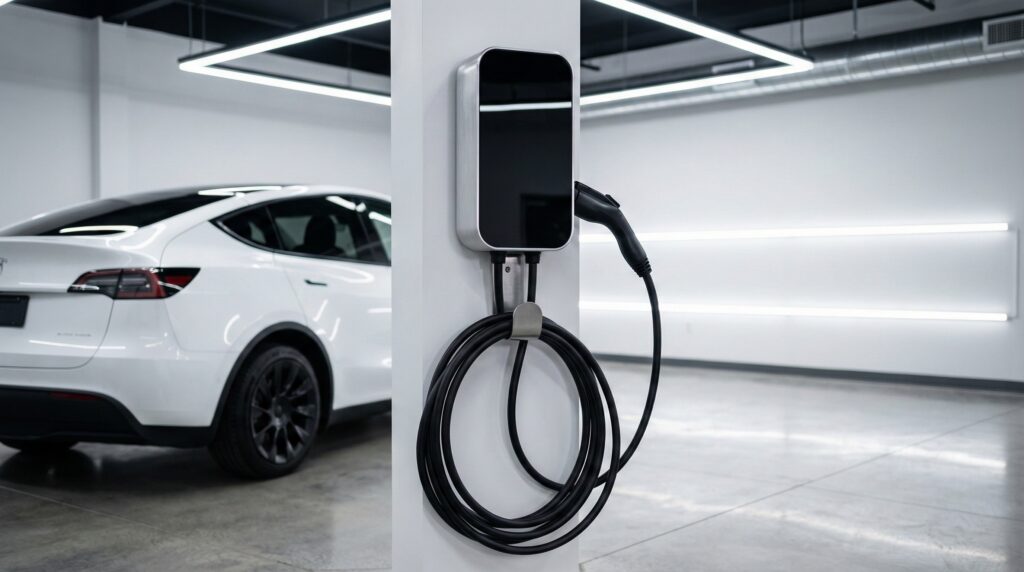
Tesla Wall Connector – Home Electric Vehicle (EV) Charger,
Best for: A Tesla-owning household in a typical single-family garage (or a driveway-side wall mount) that wants a tidy, reliable Level 2 setup and doesn’t want to think about charging every night.
The Good
- Strong day-to-day satisfaction in buyer reviews, especially around charge speed and “set it and forget it” home use.
- Clean wall-mounted design that suits permanent installs (less cable mess than many portable-style units).
- Well-known option in the Tesla ecosystem, which can simplify ownership when your primary goal is seamless compatibility.
- A good fit when you’re planning a dedicated circuit and a professional hardwired install with proper conductor sizing and torque checks.
The Bad
- Not the most flexible pick if your household expects a mix of EV brands and you want one connector that “just works” for everyone.
- Buyer reviews include compatibility/regional fit complaints — so it’s worth double-checking you’re buying the correct version for your market and vehicle inlet.
- Like any higher-power EVSE, installation quality matters a lot — it’s not a “wing it” DIY project if you’re unsure about your panel capacity.
4.8/5 across 1,961 Amazon reviews
“I installed this in my garage for my Tesla and it’s honestly one of the best upgrades I’ve made to the car.The biggest thing is charging speed. This thing is fast. I can plug in overnight and wake up to a full charge without even thinking about it. It adds a ton of range per hour compared to a standard outlet, which makes daily use way more convenient. (It…” — Verified Amazon buyer (5 stars)
“Word of Caution. This charger is not compatible with vehicles in UAE. The plug type is different to what fits in to Teslas available in UAE.” — Verified Amazon buyer (1 stars)
Our Take: If you drive a Tesla and want a straightforward, permanent Level 2 home charger, the Tesla Wall Connector is the safest “default” choice here — just confirm connector/region fit before you buy and have a licensed electrician size the circuit per NEC continuous-load rules.
Grizzl-E Ultimate Level 2 80A 19.2 kW EV Charger
Best for: A homeowner with a 200-amp service (or a robust subpanel in a detached garage) who wants a high-power-capable EVSE but plans to dial the current down to what their breaker and wiring can safely support.
The Good
- Current control/customization is a standout, which matters when you’re trying to match an EVSE to a dedicated circuit rather than chase the highest advertised amps.
- Positioned for higher-power setups (manufacturer markets it as up to 80A / 19.2 kW), which can be useful if your electrical infrastructure truly supports it.
- Customer experience includes reports of straightforward installation for some setups.
- Attractive for households that may upgrade vehicles later and want headroom — assuming the install is designed for that future capacity.
The Bad
- Connectivity/support complaints show up in buyer reviews, which is a real downside if you’re paying extra specifically for “smart” convenience.
- Higher-power EV charging raises the stakes on correct breaker sizing, conductor gauge, and torque — you’ll want a licensed electrician involved.
- Some buyer reports mention compatibility issues, so confirm connector type and vehicle fit before committing.
4.2/5 across 106 Amazon reviews
“This is a fantastic EV charger! It was easy to install, came with everything except the right size heat shrink tubing, and very customizable. I installed it 3 months ago and it not only works as advertised but has had several beneficial firmware updates! The dip switch current control is great for installing on smaller circuits making this charger super…” — Verified Amazon buyer (5 stars)
“Update: 1-6-2025 So STILL no call from support. I fully understand this charger won’t charge at 80 amps on my 2024 lighting, thats a truck issue, but my charger still won’t connect to the internet and despite emails asking for support I’ve got NOTHING from them. I even asked to speak to someone in legal, nothing. I guess I’ll just file a small claims action…” — Verified Amazon buyer (1 stars)
“my charger still won’t connect to the internet and despite emails asking for support I’ve got NOTHING from them.” — verified buyer, 1 stars
Our Take: The Grizzl-E Ultimate makes the most sense when you want a robust, adjustable EVSE and you’re willing to prioritize electrical correctness (and tolerate some app/support risk) over a “polished” smart-charging experience.
FAQ
Do I need NACS or J1772 for home charging?
You need the connector that matches your car’s inlet. Many newer EVs are moving toward NACS, while many non-Tesla EVs (especially older or current mainstream models) use J1772 for Level 2. If your household might end up with mixed EVs, talk through adapter convenience with a licensed electrician — and prioritize a safety-certified EVSE either way (look for UL/ETL listing per UL Solutions guidance).
Is a hardwired EV charger better than a plug-in model?
Often, yes — hardwired installs tend to be more “permanent,” can support higher continuous current when designed correctly, and remove one potential heat point (the receptacle connection). Plug-in can be convenient if you move or want easy replacement, but it adds receptacle quality and GFCI considerations. NEC rules for EV charging (NFPA 70, Article 625) still apply either way, and an electrician should size the circuit and configure the EVSE current limit.
How many amps do I really need at home: 32A vs 40A vs 48A?
For most drivers, 32A–48A Level 2 charging covers overnight needs comfortably — and the “right” number is whichever your panel, wiring run, and breaker can support as a continuous load. EV charging is treated as continuous, so circuit sizing and the charger’s configured output matter as much as the EVSE’s headline rating. A licensed electrician (NEC-certified) can confirm what’s appropriate for your specific panel and load calculation.
What safety certifications should I look for in an EV charger?
Prioritize third-party safety certification such as UL listing (or an equivalent nationally recognized testing lab mark like ETL) and avoid vague “meets UL standards” marketing without proof. This matters because EV charging is high power and continuous. UL certification guidance is available via UL Solutions, and installation rules are covered in NFPA’s National Electrical Code (NEC) Article 625.
What does the NEC say about EV charger circuit sizing?
NEC Article 625 covers electric vehicle power transfer systems and ties into general branch-circuit rules, including continuous-load sizing, proper overcurrent protection, and installation practices. Practically, that means your charger’s set amperage, breaker size, conductor gauge, and terminations must all line up — and you should permit/inspect where required. If you’re unsure, a licensed electrician is the right call.
Do smart chargers actually save money?
They can, but only if you’ll use the features. Scheduling can help you charge during off-peak utility rates, and energy monitoring can help you track costs. That said, some EVs can schedule charging in the car itself, so you may not need a complex app. For baseline home-charging planning, the U.S. DOE’s Alternative Fuels Data Center home charging guidance is a solid starting point.
What should I consider for outdoor EV charger installation?
Look for an EVSE with an outdoor-rated enclosure appropriate for weather exposure, and plan the mounting location to reduce direct rain/snow and keep the connector holstered off the ground. Outdoor installs also raise the importance of proper conduit/strain relief and corrosion-resistant practices. A licensed electrician should confirm the install details and local code requirements.
Bottom Line
For most Tesla-owning households, the Tesla Wall Connector is the best all-around choice from this shortlist because it’s widely used, buyer reviews strongly emphasize fast, satisfying home charging, and it fits a clean, permanent Level 2 setup. Whichever charger you choose, match the connector to your car, prioritize UL/ETL safety certification, and have a licensed electrician size the circuit per NEC Article 625 continuous-load requirements.
Affiliate disclosure: We may earn affiliate commissions from qualifying purchases. This doesn't influence our reviews.