TL;DR
The “best home charger for an EV” is the one that matches your car’s connector (NACS vs J1772), fits your home’s available electrical capacity, and is properly installed for continuous high-current use. We strongly favor safety-certified (UL or other NRTL-listed) Level 2 units and recommend having a licensed electrician (NEC-certified) confirm breaker size, wire gauge, and load calculations before you buy.
Top Recommended EV Charging
| Product | Best For | Price | Pros/Cons | Visit |
|---|---|---|---|---|
| Tesla Wall Connector – Home Electric Vehicle (EV) Charger, | Tesla / NACS households wanting a clean wall-mount | Check price on Amazon | Fast, seamless Tesla experience; compatibility can vary by vehicle/region | Visit Amazon |
| Grizzl-E Classic 40A | No-frills Level 2 charging for typical daily driving | — | Simple, commonly cross-shopped EVSE; pricing varies by configuration/retailer | Visit United |
Top Pick: Best Overall EV Charging
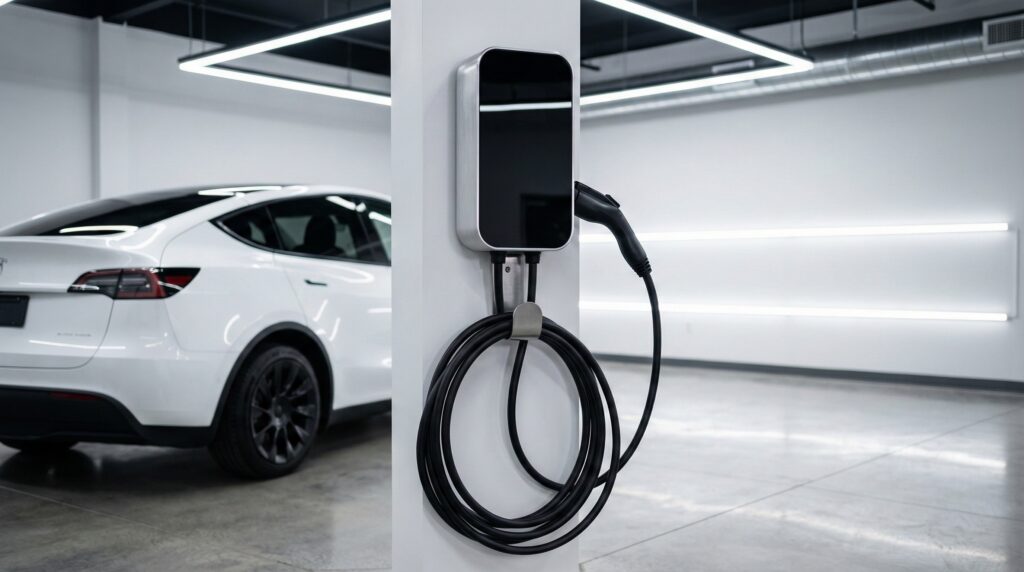
Tesla Wall Connector – Home Electric Vehicle (EV) Charger,
Best for: A Tesla (or native NACS) household that can hardwire on a properly sized circuit — especially in a two-car garage where you want a tidy daily plug-in routine and the charger will live outdoors or in an unheated space.
The Good
- Fast Level 2 charging in a clean, integrated package for many Tesla owners who want a “built for the car” experience.
- Hardwired install option that typically reduces failure points versus relying on a frequently-plugged NEMA 14-50 receptacle (installer feedback often prefers hardwire for long-term reliability).
- Good day-to-day usability for households that charge overnight and want a straightforward routine rather than lots of app tinkering.
- Right fit if you’re standardizing on NACS (for example, you already own a Tesla and plan to stick with NACS vehicles).
The Bad
- Compatibility can be region- and vehicle-dependent, so you need to confirm you’re buying the correct variant for your market and connector.
- Not the simplest choice for non-Tesla households that would rather stick with a native J1772 plug without adapters.
- Electrical requirements still matter more than the box — if your panel can’t support the circuit you want, you may need a lower-amp setup or load management.
4.8/5 across 1,961 Amazon reviews
“I installed this in my garage for my Tesla and it’s honestly one of the best upgrades I’ve made to the car.The biggest thing is charging speed. This thing is fast. I can plug in overnight and wake up to a full charge without even thinking about it. It adds a ton of range per hour compared to a standard outlet, which makes daily use way more convenient. (It…” — Verified Amazon buyer (5 stars)
“Word of Caution. This charger is not compatible with vehicles in UAE. The plug type is different to what fits in to Teslas available in UAE.” — Verified Amazon buyer (1 stars)
“The biggest thing is charging speed. This thing is fast. I can plug in overnight and wake up to a full charge without even thinking about it.” — verified buyer, 5 stars
Our Take: If you have a Tesla/NACS vehicle and can do a proper hardwired install, this is the most “set it and forget it” home charging experience in our current shortlist.
Grizzl-E Classic 40A
Best for: A homeowner who wants straightforward Level 2 charging for a typical commute — like a 30–60 mile/day driver on a 50A circuit where you don’t need maximum amps or lots of app features.
The Good
- A commonly short-listed “simple” Level 2 option when you mainly care about consistent charging rather than advanced smart features.
- 40A class charging can be a sweet spot for many homes, since it often pairs with a 50A breaker for continuous load use (final sizing should be confirmed by an electrician following NEC and the manufacturer instructions).
- Good fit for households prioritizing durability and simplicity over dashboards, graphs, and integrations.
- Frequently cross-shopped, which usually means accessories, mounting approaches, and installer familiarity are easier to come by.
The Bad
- Less compelling if you want deep smart-charging features like robust cost tracking, utility program integrations, or advanced scheduling controls.
- Pricing and configurations can vary, so you’ll want to confirm the exact version (connector type, cable length, and install type) before ordering.
Our Take: If you want a no-drama Level 2 charger and your panel supports a typical 50A circuit, the Grizzl-E Classic 40A is a solid, straightforward direction to look.
FAQ
Do I need NACS or J1772 for my EV, and what happens if I switch EV brands later?
NACS is the Tesla-style connector; J1772 is the traditional non-Tesla Level 2 connector used by many EVs. If your EV has a native port, buying a charger that matches it is the simplest day-to-day experience; adapters can work, but they add one more point of failure and one more thing to keep track of. If you think you’ll switch brands soon, consider which connector your next vehicle is likely to use and whether you’re comfortable using an adapter in the interim.
What breaker size do I need for a 48A (or 40A/32A) home charger, and why does continuous load matter?
Level 2 EV charging is a continuous load, so circuit sizing has to follow NEC continuous-load rules. As a common rule of thumb, a 48A EVSE typically calls for a 60A circuit, while a 40A EVSE commonly pairs with a 50A circuit, and a 32A EVSE often pairs with a 40A circuit — but the correct answer depends on the EVSE’s installation manual, your wire type/run length, and your panel capacity. Have a licensed electrician (NEC-certified) confirm the breaker size and conductor sizing so you’re not inadvertently overheating wiring or nuisance-tripping breakers.
Is a hardwired charger safer or faster than a plug-in charger on a 14-50 outlet?
Hardwiring is often preferred for long-term reliability because it eliminates the receptacle as a potential heat point and reduces the chance of a loose plug connection over time. Plug-in installs can be convenient (especially if you might move or swap chargers), but they rely on a properly installed, high-quality receptacle and correct protection. Speed depends on the EVSE’s configured output and circuit capacity, not whether it’s hardwired or plug-in — though some models only allow their maximum amperage when hardwired.
What safety certifications should a home EV charger have (UL vs other NRTL), and how can I verify it?
We treat third-party safety certification as non-negotiable for EVSE. UL listing is the most familiar in the US, but other NRTL marks can also be valid; what matters is that the unit is certified by a recognized lab for EV charging use and installed per the manufacturer instructions. For more background on why certification matters, see NFPA guidance and EV charging basics from the U.S. Department of Energy Alternative Fuels Data Center.
How fast will a Level 2 home charger charge my EV in real life?
Real-world charging speed depends on the charger’s amperage, your home’s circuit, and your vehicle’s onboard charger limit. Many households land in the 32A–48A Level 2 range, which generally supports overnight charging for typical commutes; the actual “miles of range per hour” varies widely by vehicle efficiency and conditions. If you want a deeper practical overview of home charging expectations, the DOE Alternative Fuels Data Center is a good starting point.
How long should the charging cable be, and where should the charger be mounted?
For many garages, a 25-foot cable is the most forgiving because it gives you flexibility to back in or pull in without “perfect parking.” Mount the EVSE where the cable naturally reaches your charge port without stretching across walkways, and aim for a placement that supports simple cord management (a holster or hook) so the connector doesn’t drag on the ground. If your only mounting spot forces the cable to cross a path, consider repositioning the EVSE or adding a ceiling-mounted cable support — daily trip hazards get old fast.
Which smart features are worth paying for if I have time-of-use rates or utility rebates?
The smart features that tend to matter are (1) scheduling around time-of-use rates, (2) basic energy/cost tracking, and (3) compatibility with utility programs or rebates (if your utility requires a specific integration). If you don’t have TOU pricing and you just charge overnight, you can often skip paying extra for app features and focus on a reliable, safety-certified unit installed correctly. For additional product-category context, Car and Driver’s charger overview is a helpful read: Car and Driver tested home EV chargers.
Bottom Line
For most households, the “best home charger for an EV” comes down to connector fit, safe circuit sizing, and a clean everyday experience — not chasing the highest amps your panel can’t support. If you’re a Tesla/NACS household and can hardwire on a properly sized circuit, the Tesla Wall Connector is our top pick because it’s fast, tidy, and easy to live with.
Affiliate disclosure: We may earn affiliate commissions from qualifying purchases. This doesn't influence our reviews.