TL;DR
The “best” at-home EV charger is the one that matches your car’s connector (NACS vs J1772), is third-party safety certified, and is sized to your electrical panel using the 80% continuous-load rule. For most homeowners, a hardwired Level 2 unit is the cleanest, most reliable way to get faster overnight charging — but a plug-in model can make sense if you already have the right 240V outlet on a properly sized dedicated circuit.
Top Recommended EV Chargers
| Product | Best For | Price | Pros/Cons | Visit |
|---|---|---|---|---|
| Tesla Wall Connector – Home Electric Vehicle (EV) Charger, | Tesla/NACS households wanting a clean hardwired setup | Check price on Amazon | Fast, polished daily use; check connector/region compatibility before you buy | Visit Amazon |
| Grizzl-E 48A Level 2 EV Charger J1772 Hardwired | Non-Tesla J1772 drivers who want 48A hardwired charging | Check price on Amazon | 48A-capable and indoor/outdoor-friendly; app experience can be a pain | Visit Amazon |
| ChargePoint Home Flex | App-first buyers who want cost visibility and utility-style UX | — | Strong mainstream mindshare and solid app features; brand-level support complaints show up often | Visit ChargePoint |
| EVIQO Evipower Gen2 | DTC shoppers who want an alternative to the “big” brands | — | Appears in some charging roundups as a viable Level 2 option; thinner buyer-review trail than mainstream picks | Visit EVIQO |
Top Pick: Best Overall EV Charger
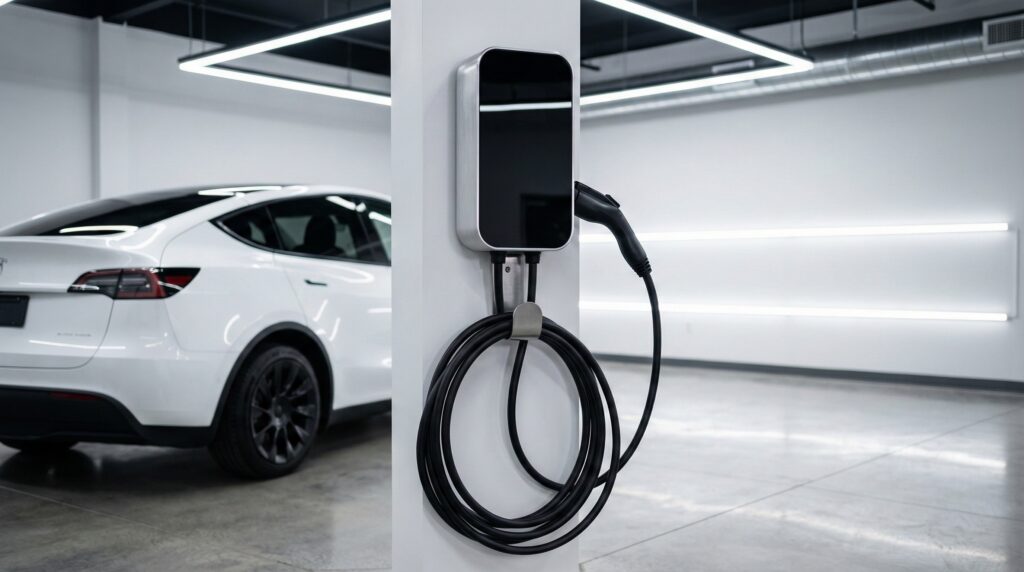
Tesla Wall Connector – Home Electric Vehicle (EV) Charger,
Best for: A Tesla or NACS-port household in a typical single-family garage where you want a tidy, hardwired Level 2 install that “just works” night after night.
The Good
- Delivers the everyday benefit most people actually care about: fast overnight Level 2 charging, so the car is ready in the morning.
- Cleaner hardwired setup than relying on a high-current receptacle — fewer connection points to loosen or overheat over time (installer-friendly when done to code).
- Designed around Tesla/NACS day-to-day ergonomics (handle fit, holster/cord management tends to feel cohesive in real garages).
- Customer experience highlights charging speed and “set it and forget it” convenience once installed and configured.
The Bad
- Not the right pick if your household is primarily J1772 without adapters — you’ll add friction for guests or mixed-EV families.
- Compatibility can be region-specific, so it’s worth double-checking connector standards and what vehicle you’re actually buying for.
- Like any hardwired EVSE, installation should be done by a licensed electrician (NEC-aware) and sized to your panel capacity — it’s not a casual DIY project.
4.8/5 across 1,961 Amazon reviews
“I installed this in my garage for my Tesla and it’s honestly one of the best upgrades I’ve made to the car.The biggest thing is charging speed. This thing is fast. I can plug in overnight and wake up to a full charge without even thinking about it. It adds a ton of range per hour compared to a standard outlet, which makes daily use way more convenient. (It…” — Verified Amazon buyer (5 stars)
“Word of Caution. This charger is not compatible with vehicles in UAE. The plug type is different to what fits in to Teslas available in UAE.” — Verified Amazon buyer (1 stars)
“Hardwired Tesla Universal Wall Connector. 50A charging max, 60A breaker, all nicely hardwired and none of the plug/outlet bullshit.” — r/evcharging discussion
“The biggest thing is charging speed. This thing is fast. I can plug in overnight and wake up to a full charge without even thinking about it.” — verified buyer, 5 stars
Our Take: If you drive a Tesla (or another vehicle with a native NACS port) and want a reliable hardwired Level 2 setup sized correctly to your panel, this is the most straightforward “buy once, use daily” pick.
Grizzl-E 48A Level 2 EV Charger J1772 Hardwired
Best for: A non-Tesla (J1772) EV owner in a garage or driveway setup who wants 48A-capable hardwired charging on a properly sized circuit — especially if you’re trying to maximize charging speed without relying on a 14-50 outlet.
The Good
- Hardwired, 48A-capable positioning is the main appeal for many households that can support it electrically (think: 60A breaker for 48A continuous charging under the 80% rule).
- J1772 connector is the default “broad compatibility” choice for many non-Tesla EVs, and it can also serve Teslas with the right adapter.
- Often discussed as a popular, well-known EVSE line in homeowner/installer conversations.
- Indoor/outdoor-capable positioning makes it easier to place near a garage door or on an exterior wall (as long as your installation location and fittings are weather-appropriate).
The Bad
- Buyer reviews repeatedly call out frustration with app behavior and rate features — which matters if you rely on time-of-use scheduling.
- If “smart” features are your priority, you may end up using your car’s scheduling instead of the charger’s app.
- Hardwired installation still requires doing the electrical work right: correct wire gauge, correct breaker, correct torque, and proper strain relief.
4.3/5 across 300 Amazon reviews
“I have an EV, not a plug-in hybrid. It came with a charging cable. I was thinking about just having a dedicated 240-volt outlet installed until I found out that I could only charge at a maximum of 40 amps (80% of a 50-amp circuit breaker max for an outlet) rather than my car’s maximum and fastest 48 amps. Plus, the electrician informed me about some outlet…” — Verified Amazon buyer (5 stars)
“Update Feb 7, 2026I bought the charger because it has a metal enclosure and unfortunately, I needed to mount mine on a south facing wall. It will be baked in the hot Arizona sun all summer. I also wanted something NOT made in China. In those respects, I am happy with the charger. That is the end of my joy however.I absolutely hate the app! Where I live, my…” — Verified Amazon buyer (1 stars)
“These are some of the more popular and well reviewed EVSE’s: ChargePoint Home Flex ($60 off promo ends 8/27) Emporia Classic Grizzl-E Ultimate Tesla Universal Wall Connector” — r/evcharging discussion
“I was thinking about just having a dedicated 240-volt outlet installed until I found out that I could only charge at a maximum of 40 amps (80% of a 50-amp circuit breaker max for an outlet) rather than my car’s maximum and fastest 48 amps.” — verified buyer, 5 stars
Our Take: If you want J1772 compatibility and you’re specifically chasing a clean 48A hardwired setup on a 60A circuit, Grizzl-E is a strong hardware-centric option — just don’t buy it for the app.
ChargePoint Home Flex
Best for: A homeowner on time-of-use rates who cares about app-based visibility (cost, sessions, history) and wants a charger line that’s widely recognized — for example, in a utility-rebate-heavy area where ChargePoint is commonly mentioned.
The Good
- Frequently recommended in mainstream “best home charger” discussions, so installers tend to be familiar with it.
- App experience can be a plus for tracking cost and usage, especially if you’re monitoring off-peak charging.
- A recognizable, established name in EV charging — which can matter for long-term ecosystem confidence.
- Often comes up in community lists alongside other well-known EVSE brands, making it easy to compare.
The Bad
- Brand-level customer experience signals around support can be a concern — enough that it comes up repeatedly in buyer conversations.
- We wouldn’t pick it if your priority is “simple, minimal app dependence” rather than feature depth.
- Pricing is hard to generalize from the information available here, so you’ll want to comparison shop carefully.
1.2/5 across 356 Trustpilot reviews (source)
“I previously had a juicebox, before recently getting the charge point home flex. I HIGHLY recommend the charge point. It’s super super easy to set up and use, and nice to have the app tell me exactly how much it’s costing me.” — r/evcharging discussion
“How are you liking it? I’m torn between the emporia, autel, and charge point. Seems like they are all pretty similar except for the charge point costing more and having zero support according to a lot of the reviews.” — r/evcharging discussion
Our Take: Choose the Home Flex when you value app-driven cost visibility and you’re comfortable buying into a big ecosystem — but go in with eyes open about support complaints and keep your install rock-solid.
EVIQO Evipower Gen2
Best for: A DTC-minded shopper who wants a Level 2 home charger option outside the usual “utility-promoted” names — for example, a homeowner outfitting a second garage bay and willing to do extra homework on specs and support.
The Good
- A direct-to-consumer alternative that shows up in some EV charger roundups, which can make it appealing if you’re trying to avoid the biggest brands.
- DTC purchasing can be straightforward if you prefer ordering directly from the manufacturer rather than through marketplaces.
- Can fit buyers who mainly want reliable Level 2 charging basics (and plan to schedule charging in-car if needed).
The Bad
- There’s limited buyer-review detail available in the information we’re working from here, so we have less real-world signal on long-term reliability and support outcomes.
- Without clearer published-at-a-glance specs in this dataset, you’ll need to verify the exact connector, max amperage, certification, and enclosure rating before committing.
Our Take: This is the “do your homework” pick — potentially fine if the model you’re considering is properly certified and spec’d for your install, but we’d stick with a more review-proven unit if you want maximum peace of mind.
FAQ
Do I need a NACS or J1772 home EV charger?
Match the connector to your car’s charge port for daily convenience: Teslas and many newer EVs use NACS, while many non-Tesla models use J1772 for Level 2 charging. Adapters can bridge the gap, but in a shared household (or for guests) the extra step becomes a real usability tax.
Hardwired vs plug-in EV charger: which is better?
Hardwired is usually the “best overall” choice for a permanent home setup because it can support higher continuous current and eliminates a high-amperage plug/receptacle connection point. Plug-in can be a good fit if you already have the correct 240V outlet on a dedicated, correctly sized circuit and you want easier replacement or portability — but you should still have a licensed electrician verify the receptacle quality, wire size, and breaker sizing to NEC expectations (NFPA 70).
What amperage should I choose for an at-home Level 2 charger?
Size the charger to your electrical capacity using the 80% continuous-load rule: a 50A breaker typically supports up to 40A continuous charging, and a 60A breaker typically supports up to 48A continuous charging. Many drivers do perfectly well with 32A–40A overnight, but the right answer depends on your daily miles, your EV’s onboard charger limit, and what your panel can safely support.
What safety certifications should an at-home EV charger have?
Prioritize third-party safety certification such as UL listing (or equivalent testing/certification) rather than relying on marketing claims. If you’re unsure what “listed” means or why it matters, it’s worth reading UL’s guidance on product certification through UL Solutions, and having an NEC-certified electrician confirm the overall circuit protection approach for your install.
Is a NEMA 14-50 outlet enough for a 48-amp EV charger?
Usually not: 48A continuous charging typically calls for a 60A circuit, and NEMA 14-50 receptacle installations are commonly paired with a 50A breaker — which generally means 40A max continuous charging under the 80% rule. If you want 48A, hardwiring is typically the cleaner path, and you should have an electrician size the wiring, breaker, and EVSE settings correctly.
How long should an EV charger cable be for home use?
For most garages and driveways, 20–25 feet is the practical sweet spot: it gives you flexibility for different parking positions without pulling the cable tight. Too-short cables force precision parking and increase wear on the connector and strain relief over time.
Where can I learn the basics of Level 1 vs Level 2 home charging?
The clearest plain-English overview is the U.S. Department of Energy’s Alternative Fuels Data Center home charging guide, which explains the difference in power level and what that means in real home use. It’s also a good starting point before you talk with an electrician about your specific panel capacity and circuit routing.
Bottom Line
For most US households, the best at-home EV charger is a third-party safety certified Level 2 unit that matches your connector (NACS or J1772) and is installed on a correctly sized dedicated circuit using the 80% rule. If you drive a Tesla or have a NACS port and want a clean hardwired setup, the Tesla Wall Connector is our top overall pick for daily reliability and fast overnight charging.
Affiliate disclosure: We may earn affiliate commissions from qualifying purchases. This doesn't influence our reviews.