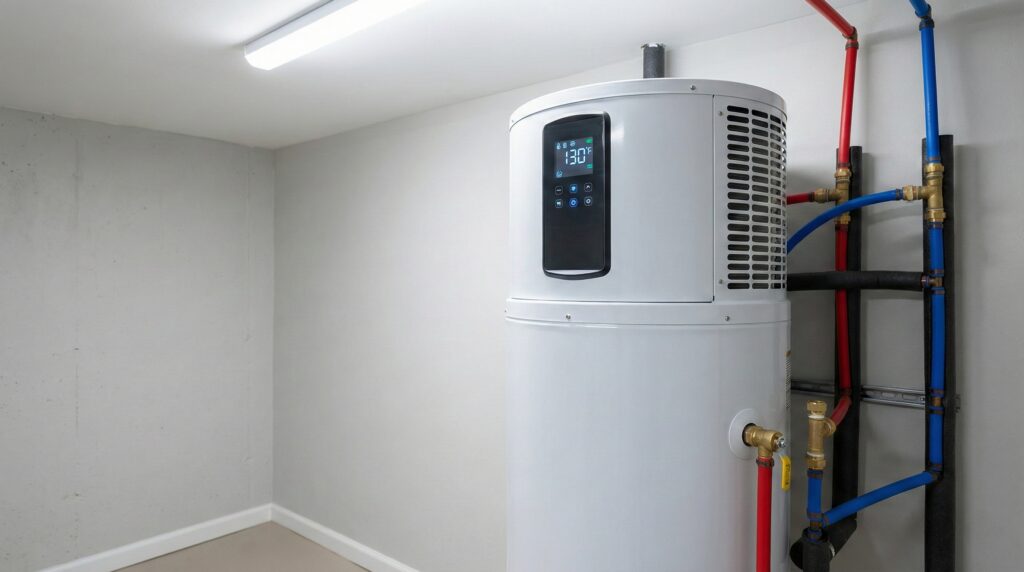
Tankless water heater cost can feel confusing because the price you see online is rarely the price you pay installed. Below, we break down what typically drives your total cost — unit, labor, electrical or gas upgrades, venting, permits, and ongoing maintenance — so you can budget with fewer surprises.
Need to Know
Our editorial team reviewed the best-available home_electrification guidance and community owner reports to answer this. Tankless water heater cost is best understood as total installed cost, not just the heater price, because many homes need electrical, gas-line, venting, or plumbing changes to support a tankless unit. Evidence from manufacturer documentation, utility program rules, and peer-reviewed energy research suggests your long-run cost depends as much on usage patterns and upkeep as on efficiency claims.
Quick Answer
In the U.S., tankless water heater cost typically ranges from a few thousand dollars installed to several thousand dollars installed, depending on whether it’s electric or gas, how much rewiring/repiping/venting is required, and local labor rates. For an accurate number in your home, you’ll want quotes that include permits, any panel/service upgrades, venting (for gas), and the exact electrical circuit or gas-line sizing required.
What This Usually Means
When you search “tankless water heater cost,” you’re usually trying to reconcile three different numbers that get mixed together online: (1) the sticker price of the unit, (2) the installation cost in a straightforward swap, and (3) the all-in cost when your home needs upgrades. We’ve seen homeowners surprised when a “good deal” unit turns into a bigger project because tankless systems can demand higher electrical capacity (electric models) or correct gas supply/venting (gas models). That’s why cost discussions that ignore infrastructure are almost always misleading.
Another big reason tankless water heater cost varies is that “tankless” isn’t one thing. Whole-home units sized for multiple simultaneous fixtures generally cost more than point-of-use units that serve a single bathroom or remote sink. And while tankless heaters can reduce standby losses compared with tanks, your real operating cost depends on incoming water temperature, how often you use hot water, your energy prices, and whether you keep up with maintenance (especially descaling in hard-water areas).
Finally, many people are really asking a lifetime-cost question: “Will this cost me less over time than a tank?” That answer depends on your existing setup and what would be required to switch. The U.S. Department of Energy’s consumer guidance is a good starting point for understanding efficiency concepts and usage patterns, while NREL research is often referenced in broader electrification modeling and cost-of-energy discussions. If you’re considering an electric tankless model, it’s also wise to think through code and safety: electrical work should align with the NFPA’s National Electrical Code (NEC), and equipment should be listed (commonly to UL Solutions standards) as appropriate for its installation environment.
“We have one and wouldn’t go back. Never run out of hot water and more efficient so less cost overall. We have a natural gas one and have heard that is much better than electric but haven’t had one ourselves.” r/homeowners
What Can Help
- Ask for an “all-in installed” quote in writing. For tankless water heater cost, the important line items are permits, disposal of old equipment, new shutoffs/valves, venting (gas), condensate drain (many high-efficiency gas units), and any electrical or gas supply upgrades.
- Clarify whether you’re pricing electric or gas tankless. Electric tankless often triggers higher-amperage circuits and possibly a service/panel upgrade; gas tankless often triggers venting changes and gas-line sizing work. Those are different cost profiles.
- Confirm sizing based on your actual use. A unit that’s too small can force you into rework costs later; a unit that’s oversized can raise upfront cost without meaningful savings. An HVAC contractor (NATE-certified) or experienced plumber will typically size based on your simultaneous-flow needs and local incoming water temperature assumptions.
- Budget for electrical capacity checks. If you’re in the home electrification mindset, electric tankless can look appealing — but your total tankless water heater cost can jump if your panel is full, your service is limited, or your wiring route is complex. A licensed electrician (NEC-certified) can tell you quickly whether new breakers, larger conductors, or a service upgrade are likely.
- Check your water hardness and plan for scale control. In hard-water regions, descaling can be a predictable ongoing cost (supplies and/or service). Some homeowners add filtration/conditioning, which is a separate cost but may reduce maintenance headaches.
- Compare against a high-efficiency tank as a cost baseline. Sometimes your lowest total installed cost is a conventional or hybrid tank, especially if switching to tankless requires major venting or electrical work. If you want background on typical electric options, see our hub on electric hot water heaters for context on what “standard install” often looks like.
- Ask about rebates and tax credits — but treat them as “maybe,” not guaranteed. Utility rebates can change mid-year and may require specific efficiency tiers or professional installation. For federal incentives, consult the IRS guidance for Inflation Reduction Act (IRA) tax credit rules that may apply to certain water-heating upgrades, and keep documentation.
- Get at least two quotes that specify scope. Tankless water heater cost swings heavily with scope: “replace unit only” vs “bring venting to code” vs “upgrade gas line from meter” vs “panel upgrade.” Quotes that clearly list assumptions are easier to compare.
“Mine came out to the same but it always a 75 gal conversion. Paid 1100 labor + 1350 parts + 1350 for the water heater (Rinnai RX199iN). Getting a 1350 rebate from SoCalGas, a 100 rebate from Rinnai and 600 federal credit. So total cost is around 1850.” r/askaplumber
What to Avoid
- Don’t budget using online “unit-only” prices. The heater is often the smaller part of tankless water heater cost once you include venting, valves, electrical circuits, or gas-line work.
- Don’t assume electric tankless is a simple swap for an electric tank. Many whole-home electric tankless units need multiple large circuits; if your panel/service can’t support it, your installed cost can change dramatically.
- Don’t assume gas tankless is “drop-in” for a tank-style gas heater. Venting materials, routing, termination location, condensate handling, and gas-line sizing can all add cost.
- Don’t ignore maintenance costs in hard-water areas. Even if your operating cost looks good, scale can increase service calls and reduce performance; that can change your true lifetime cost.
- Don’t skip permits or inspections to save money. For anything involving combustion venting or major electrical changes, permit/inspection costs are often small compared with the risk of unsafe or noncompliant work. Electrical requirements should align with the NFPA (NEC), and installed equipment should be appropriately listed (commonly via UL Solutions).
- Don’t let “infinite hot water” hide the cost of higher usage. Some households use more hot water once they stop worrying about running out; that can raise energy bills and shift your total cost of ownership.
“The tank heater problem sat there for 14 years and you did nothing to it. A tankless heater requires a yearly cleaning and it will definitely go down more than once in 14 years. The cost of maintenance and repairs will negate any efficiency savings.” r/askaplumber
When to Consult a licensed electrician (NEC-certified) or HVAC contractor (NATE-certified)
- You’re considering electric tankless and your panel is older, crowded, or you’re unsure of service size. A licensed electrician (NEC-certified) can evaluate load calculations, breaker space, conductor sizing, and whether a service/panel upgrade is likely — key drivers of tankless water heater cost.
- You’re switching fuel types (gas to electric or electric to gas). Fuel switching can trigger multiple trades (electrical, plumbing, venting) and sometimes additional permits — often the biggest source of cost overruns.
- Your gas unit would need new or relocated venting. An HVAC contractor (NATE-certified) can assess vent category, routing, clearances, and condensate requirements; venting scope is a major swing factor in installed cost.
- You have hard water, recurring scale, or a history of fixture clogging. A pro can recommend realistic maintenance intervals and whether pre-treatment makes economic sense for your home.
- Your home has long pipe runs or you’re unhappy with wait times for hot water. A contractor can explain whether a tankless setup, a recirculation strategy, or pipe insulation changes your total cost and comfort — without guessing.
- You want to ensure eligibility for rebates/credits. Many programs require licensed installation, model documentation, and compliance sign-offs; a reputable contractor can help you avoid paperwork mistakes that effectively raise your net cost.
FAQ
What factors most affect tankless water heater cost?
The biggest factors are fuel type (electric vs gas), the amount of infrastructure work required (new electrical circuits or panel/service upgrades for electric; gas-line sizing and venting for gas), and local labor/permit costs. Your home’s layout matters too: long runs, tight utility closets, or hard-to-access routing can add labor time. Finally, your water hardness can raise ongoing maintenance cost and influence whether you add filtration/conditioning.
Is electric or gas tankless cheaper to install?
It depends on what your home already has. Electric tankless can be expensive to install if it requires multiple high-amperage circuits or a panel/service upgrade; gas tankless can be expensive if venting must be rebuilt or the gas line from the meter must be upsized. The cheapest path is usually the one that minimizes required upgrades, which is why home-specific quotes matter.
How much does maintenance add to the total cost of owning a tankless water heater?
Maintenance cost varies widely by water quality and how the system is used. In hard-water areas, periodic descaling is a common ongoing expense, whether you do it yourself (supplies and time) or pay for service. Over years of ownership, routine maintenance plus occasional repairs can materially change your true “lifetime cost,” so it’s smart to include it in your budget assumptions.
Can a tankless water heater qualify for rebates or federal tax credits?
Sometimes, but eligibility depends on the exact technology, efficiency rating, and program rules in effect when you install. Utility rebates are location-specific and can require approved equipment lists and licensed installation. For federal incentives, check the IRS guidance related to Inflation Reduction Act (IRA) credits and keep invoices and product documentation in case you need to substantiate eligibility.
Does a tankless water heater always lower your monthly energy bill?
Not always. Tankless units can reduce standby losses compared with tank heaters, but your results depend on hot-water usage patterns, incoming water temperature, and energy prices. Also, some households use more hot water once they stop worrying about running out, which can offset efficiency gains; the U.S. Department of Energy’s consumer materials are helpful for thinking through usage-driven outcomes.
Bottom Line
Tankless water heater cost is typically “a few thousand to several thousand dollars installed,” and your specific number hinges on upgrades: electrical capacity for electric models and venting/gas-line work for gas models. The most reliable way to control cost is to price the full scope — permits, code-compliant electrical work per NFPA (NEC), appropriately listed equipment (often aligned with UL Solutions), and realistic maintenance — before you commit. We’d stick with detailed, scope-based quotes and revisit if new research shifts the consensus.