TL;DR
Selecting the best electric water heater involves looking past the shiny exterior and focusing on tank thickness, recovery rates, and energy efficiency. While many homeowners are drawn to the space-saving promises of tankless units, real-world data and professional plumbing feedback suggest that traditional tanks—especially heat pump hybrids—offer more consistent performance for most households. For pure longevity, the Bradford White RE Series remains a top choice among pros due to its build quality. For those looking to slash utility bills, the Rheem Performance Platinum Hybrid is the efficiency leader, though it requires specific installation conditions. If you are outfitting a small ADU, the Rheem RTEX series provides a compact solution, provided your hot water expectations are modest.
Your home’s energy footprint is largely dictated by how you heat your water. It is usually the second-largest energy expense after climate control. Whether you are replacing a leaking relic or planning an all-electric transition, understanding the trade-offs between tank capacity, UEF ratings, and maintenance requirements will save you thousands of dollars over the next decade. This guide breaks down the top performers based on build quality, efficiency, and honest user feedback from those who have lived with these units for years.
| Product Name | Best For | Price Range | Pros/Cons | Visit |
|---|---|---|---|---|
| Bradford White RE Series | homeowners who want a “set it and forget it” solution and are willing to pay … | Check price on Amazon | ✅ Superior Build: Noticeably heavier than budget com; Maintenance-Friendly: Often comes with a brass dra ❌ Restricted Purchase: It can be difficult for DIYer; Price Point: You will pay a premium over store bra |
|
| Rheem Performance Platinum Hybrid | energy-conscious owners in warmer or moderate climates with a garage or basement | Check price on Amazon | ✅ Extreme Savings: Can pay for itself in energy savi; Cooling Side Effect: Dehumidifies and slightly coo ❌ Noise Levels: The heat pump fan sounds like a wind; Space Requirements: Needs roughly 1,000 cubic feet |
|
| Rheem RTEX Series | small apartments or single-occupant homes in warm climates | Check price on Amazon | ✅ Space Saver: Wall-mounted design frees up an entir; No Standby Loss: You only pay for electricity when ❌ The “Trickle” Factor: If you try to pull more wate; Heavy Electrical Load: May require 2 or 3 dedicate |
|
| AO Smith Signature 100 Series | large families who need a reliable, high-volume hot water supply and don’t ha… | Check price on Amazon | ✅ High Recovery Rate: Reheats water relatively quick; Ease of Repair: Standard elements and thermostats ❌ Efficiency: This is a standard electric resistance; Anode Rod: The stock anode rod is often basic; you |
|
| Top Picks for Kettles and Dispensers | those who drink tea or coffee throughout the day | Check price on Amazon | See detailed review |
Top-Rated Electric Water Heaters by Category
1. Best Traditional Tank: Bradford White RE Series
If you talk to a plumber with twenty years of experience, they will likely point you toward Bradford White. These units aren’t usually found in the aisles of big-box retail stores; they are primarily sold through wholesale supply houses. The reason for their reputation is simple: they are built heavier. A heavier tank generally means thicker steel walls and more robust welds, which are the primary defense against the internal corrosion that eventually kills every tank heater.
The RE Series features the Hydrojet Total Performance System, which uses cold water inlet turbulence to reduce sediment buildup. This is a vital feature if you live in an area with hard water, as sediment creates an insulating layer at the bottom of the tank that forces the lower heating element to work much harder, eventually burning it out.
The Good
- Superior Build: Noticeably heavier than budget competitors, indicating a thicker internal glass lining.
- Maintenance-Friendly: Often comes with a brass drain valve rather than the flimsy plastic ones found on retail models.
- Pro-Grade Support: Parts are widely available through plumbing supply networks.
The Bad
- Restricted Purchase: It can be difficult for DIYers to buy these directly, as the company prioritizes professional installers.
- Price Point: You will pay a premium over store brands for the peace of mind.
💰 Street Price: $1,200 – $2,500
Should You Buy? Best for homeowners who want a “set it and forget it” solution and are willing to pay for a professional installation. Skip if you are on a tight budget and need a unit you can throw in the back of your truck today.
2. Best for Energy Efficiency: Rheem Performance Platinum Hybrid
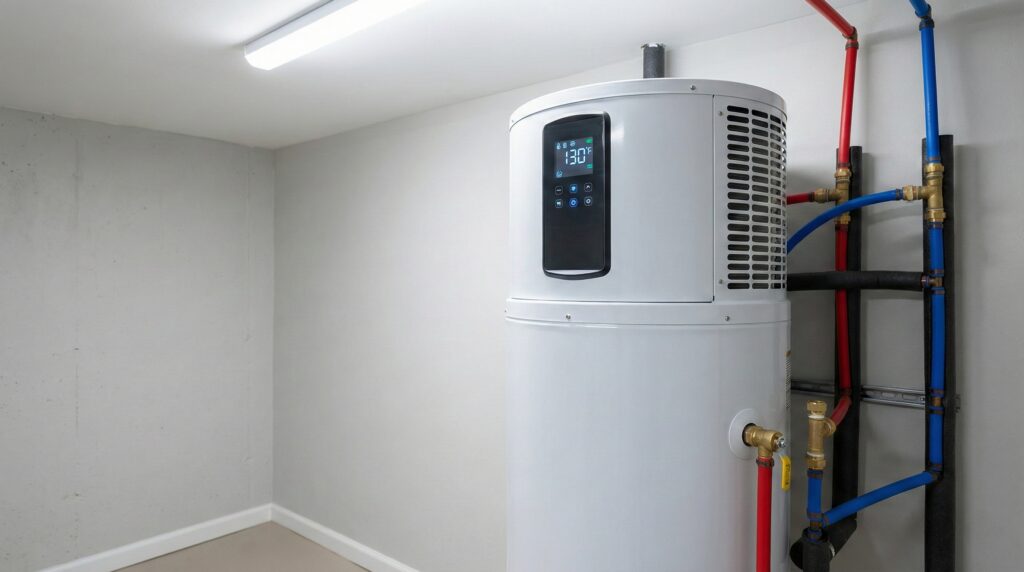
For those focused on water heating systems that actually cut costs, the Rheem Hybrid is the current champion. It works like a refrigerator in reverse, pulling heat from the surrounding air and dumping it into the water. This process is incredibly efficient, often achieving a UEF (Uniform Energy Factor) above 3.5, whereas a standard electric tank sits around 0.93.
In practice, this means your water heating costs could drop by 60% or more. The unit also includes smart features, such as leak detection and mobile alerts, which are increasingly common in modern heating and cooling technology. If you already use the best smart thermostat to manage your home’s air, adding a smart water heater is the logical next step for a truly connected home.
The Good
- Extreme Savings: Can pay for itself in energy savings in as little as 3-5 years.
- Cooling Side Effect: Dehumidifies and slightly cools the room where it is installed (great for garages or basements).
- Leak Protection: Built-in shutoff valve prevents catastrophic flooding if a leak is detected.
The Bad
- Noise Levels: The heat pump fan sounds like a window AC unit; avoid installing it near a bedroom wall.
- Space Requirements: Needs roughly 1,000 cubic feet of air space to operate efficiently unless you duct the air.
💰 Street Price: $1,300 – $2,000
Should You Buy? Best for energy-conscious owners in warmer or moderate climates with a garage or basement. Skip if you must install the unit in a tight closet inside your living area.
3. Best Tankless for Small Spaces: Rheem RTEX Series
Electric tankless units are often misunderstood. Unlike gas tankless heaters, which have massive heating power, electric versions are limited by the amount of amperage your home can provide. The Rheem RTEX series is excellent for point-of-use applications, like an ADU or a remote guest bathroom, but it struggles as a whole-home solution in the northern half of the country.
The unit is incredibly compact, about the size of a large briefcase, which frees up floor space for other electric kitchen appliances or storage. However, you must be realistic about the flow rate. If your incoming water is 40°F, you won’t be running two showers simultaneously.
The Good
- Space Saver: Wall-mounted design frees up an entire closet or utility corner.
- No Standby Loss: You only pay for electricity when the tap is actually open.
- Infinite Hot Water: As long as you stay within the flow limit, you will never run out of hot water.
The Bad
- The “Trickle” Factor: If you try to pull more water than the unit can heat, the temperature or the flow will drop significantly.
- Heavy Electrical Load: May require 2 or 3 dedicated double-pole 40-amp breakers, which often necessitates a panel upgrade.
💰 Street Price: $250 – $1,000
Should You Buy? Best for small apartments or single-occupant homes in warm climates. Skip if you have a family of four and live in a cold region.
4. Best High-Capacity: AO Smith Signature 100 Series
When you have a household of five people all trying to get ready at the same time, capacity is king. The AO Smith Signature 100 Series is a workhorse that handles high-demand scenarios without the complexity of hybrid technology. While it isn’t as efficient as a heat pump, it is reliable and much easier to service if a heating element goes out.
Homeowners often appreciate the straightforward design. It uses dual 4,500-watt copper heating elements and a tank lined with “PermaGlas” to resist corrosion. While it’s a “big box” brand, the Signature 100 remains a step up from the base models found in discount aisles.
The Good
- High Recovery Rate: Reheats water relatively quickly for a standard tank.
- Ease of Repair: Standard elements and thermostats are available at any hardware store.
- Reliable: Simple design means fewer electronics to fail compared to smart or hybrid models.
The Bad
- Efficiency: This is a standard electric resistance heater; it will be your most expensive appliance to run.
- Anode Rod: The stock anode rod is often basic; you should plan to replace it sooner rather than later.
💰 Street Price: $400 – $1,200
Should You Buy? Best for large families who need a reliable, high-volume hot water supply and don’t have the budget or space for a hybrid unit. Skip if you are trying to minimize your monthly utility bills.
Crucial Buying Factors: Beyond the Spec Sheet
Understanding UEF (Uniform Energy Factor)
In the past, we looked at “Energy Factor,” but the industry now uses UEF to give a more accurate picture of real-world use. A standard electric heater usually lands around 0.92 to 0.94. This means 92% of the energy is transferred to the water. Heat pump hybrids, however, often hit 3.5 to 4.0. Essentially, for every dollar of electricity you put in, you get four dollars’ worth of heat. Over the fifteen-year life of a heater, that difference can amount to $5,000 in savings.
Sizing Your System: GPM vs. Tank Capacity
Many homeowners think they need an 80-gallon tank just because they have two showers. However, as users on Reddit often point out, a standard 2.5 GPM shower head only uses about 1.25 GPM of hot water (mixed with cold to reach a comfortable temperature). A 50-gallon tank can typically provide about 20-30 minutes of concurrent showering before the temperature drops significantly. Unless you have a massive soaking tub or a multi-head “car wash” shower, a 50-gallon high-recovery unit is usually sufficient for 3-4 people.
The ‘Big Box’ vs. ‘Plumbing Supply’ Quality Gap
There is a persistent debate about whether a Rheem or AO Smith unit bought at a home improvement store is the same as one bought at a wholesaler like Ferguson. Plumbers argue that wholesale units often feature brass drain valves and more durable internal components, whereas retail models use plastic components to hit a lower price point. If you have the choice, buying from a plumbing wholesaler often results in a unit that lasts several years longer.
What Real Users Are Saying (Reddit Insights)
General Sentiment
Across the DIY and plumbing subreddits, the consensus is that electric water heaters have become somewhat “commoditized,” with one major exception: the thickness of the tank. Professionals consistently rank Bradford White at the top because of the physical weight of the units. As one user noted, “a quality plumbing fixture is generally heavier in weight,” and that extra steel is what prevents leaks in year ten. There is also a strong movement toward “electrifying everything,” but with a heavy dose of realism regarding the limitations of electric tankless units in cold climates.
Top Complaints & Warnings
The most vocal complaints center on two areas: Rheem’s warranty process and the performance of electric tankless heaters.
“Mine barely was able to achieve a 140 degree water temperature and the flow rate at that temperature was far too low to even take a shower… absolute garbage.” — r/Plumbing
Users also warn that even “high-end” units from retail stores sometimes arrive with broken dip tubes or faulty control boards. While warranties usually cover the parts, the “hassle factor” of diagnosing the issue and waiting for shipping can leave a family without hot water for a week.
Budget Tips & Value Picks
The community’s favorite “longevity hack” is not a specific brand, but a specific upgrade: the powered anode rod. By spending an extra $150 on a Corro-Protec or similar electronic anode, you can theoretically stop tank corrosion entirely. Users also recommend immediately swapping out plastic drain valves for brass ones ($20 part) to ensure you can actually flush the tank for maintenance without the valve snapping off in three years.
Longevity Hacks: Making Your Heater Last 25 Years
The Powered Anode Rod Upgrade
Every tank heater comes with a “sacrificial” anode rod made of magnesium or aluminum. Its job is to corrode so the steel tank doesn’t. Once that rod is gone, the tank is next. A powered anode rod uses a small electrical pulse to achieve the same result without the rod itself dissolving. This is the single most effective way to prevent the “bottom-out” leaks that usually end a heater’s life.
Inline Ionizers and Filtration
If you have hard water, scale buildup is your heater’s enemy. Systems like the Halo Ionizer or simple sediment filters prevent minerals from calcifying on the heating elements. This keeps your recovery time fast and prevents the “popping” sound often heard in older heaters as water gets trapped under layers of scale and boils.
Specialty Electric Water Boilers
For kitchen use, you may not want to wait for a 50-gallon tank to heat up just for a cup of tea. High-end countertop boilers provide “instant” hot water more efficiently than a stove.
Top Picks for Kettles and Dispensers
- Zojirushi CV-DGQ: Often called the “Gold Standard” by the Buy It For Life community. It uses vacuum insulation (like a Yeti cup) to keep water hot with almost zero energy draw.
💰 Street Price: $20 – $300
Should You Buy? Best for those who drink tea or coffee throughout the day. Skip if you only need hot water once a week.
- Saki Stainless Steel Samovar: One of the few options with an all-steel interior, avoiding plastic-to-water contact.
Should You Buy? Best for large gatherings or those sensitive to plastic. Skip if you have limited counter space.
- Graef WK 901: German-engineered with a double-wall steel design that stays cool to the touch on the outside.
Should You Buy? Best for families with small children who might touch the kettle. Skip if you need more than 1.5 liters of capacity.
Best Electric Water Heaters by Segment
Best for 1-Bedroom ADUs
The Rheem RTEX-13 is the sweet spot for small detached living spaces. It provides enough flow for a single shower and a kitchen sink simultaneously without the massive footprint of a tank. You can see its details in our tankless review section above.
Best for Large Families (4-5 people)
The AO Smith Signature 100 Series 80-gallon model is the traditional choice, but if you have the space, the Rheem 80-Gallon Hybrid is the superior long-term investment. It provides the volume needed for back-to-back showers while keeping the monthly bill low.
Best for Rural Homes Without Gas
In rural areas where electricity is the only utility, reliability is paramount. The Bradford White RE Series is the favorite here because it is built to withstand the slight fluctuations in water pressure and quality often found in well-water systems.
Frequently Asked Questions
Is 80 gallons necessary for a two-person household?
Generally, no. A two-person household can easily get by with a 40- or 50-gallon tank like the AO Smith Signature 100. Most modern showers use about 2.5 gallons per minute, and since you mix hot and cold water, you’re only drawing about 1.25 gallons of hot water per minute. An 80-gallon tank is usually reserved for homes with massive soaking tubs or households with 5 or more people who all shower at the same time.
Why are electric tankless heaters often considered ‘garbage’ for showers?
This reputation comes from the “temperature rise” limitation. Heating water instantly requires an immense amount of electricity. In cold climates where incoming water is 40°F, an electric tankless unit like the Rheem RTEX might only be able to heat 1.5 gallons per minute to a comfortable temperature. This results in a weak, low-pressure shower that many users find frustrating. In warmer climates, they work much better.
What is the Uniform Energy Factor (UEF) and why does it matter?
UEF is the standardized rating for water heater efficiency. The higher the number, the more efficient the unit. Standard electric tanks have a UEF around 0.93, while hybrid heat pump models can reach 3.8. Choosing a high-UEF model like the Rheem Performance Platinum can save a typical family hundreds of dollars per year on their utility bills, making it a key factor in any home heating and cooling strategy.
Why is Bradford White considered better than Rheem or AO Smith by plumbers?
Plumbers prefer Bradford White primarily because of their build quality and distribution model. They are sold through wholesalers rather than big-box stores, and they tend to have thicker steel tanks and superior welds. This makes them significantly heavier and more durable over time. While a Rheem Performance Platinum is great for tech and efficiency, the Bradford White is the choice for pure, long-term structural reliability.
How does a heat pump water heater differ from a traditional electric tank?
A traditional tank uses electric resistance coils (like a giant toaster) to heat the water. A heat pump water heater, or “hybrid,” uses a compressor to move heat from the air into the water. This is much more efficient but requires air space for the unit to “breathe” and produces some fan noise. Many homeowners find that the massive energy savings outweigh the installation requirements.
Final Thoughts
Choosing the best electric water heater for your home isn’t just about the initial price tag; it’s about the “total cost of ownership” over the next fifteen years. If you want the most durable tank on the market, look for a Bradford White through a local plumber. If you want to slash your monthly bills and contribute to a more efficient home, the Rheem Performance Platinum Hybrid is the clear winner. For small point-of-use needs, the Rheem RTEX series offers a compact, if limited, solution. Regardless of which model you choose, remember that a $150 investment in a powered anode rod can be the difference between a 10-year lifespan and a 25-year one. Taking care of your home’s electrification now ensures a more comfortable, efficient, and worry-free future.
Disclosure: We earn a small commission on qualifying purchases through our Amazon links, at no extra cost to you. This helps us continue to provide honest, deeply researched advice for your home electrification journey.
Affiliate disclosure: We may earn affiliate commissions from qualifying purchases. This doesn't influence our reviews.