TL;DR
If you want one portable EV charger that can handle real overnight refills, prioritize a safety-certified portable Level 2 EVSE that matches your car’s connector (J1772 for most non-Tesla vehicles, NACS for Tesla) and the 240V outlet you’ll actually use most (often NEMA 14-50). For most homeowners, electrical compatibility and safety listing matter more than screens or app features.
If you mostly need an emergency/travel backup, a basic Level 1 (120V) option is slower but works in far more places — just keep expectations realistic.
What Portable EV Chargers Actually Are
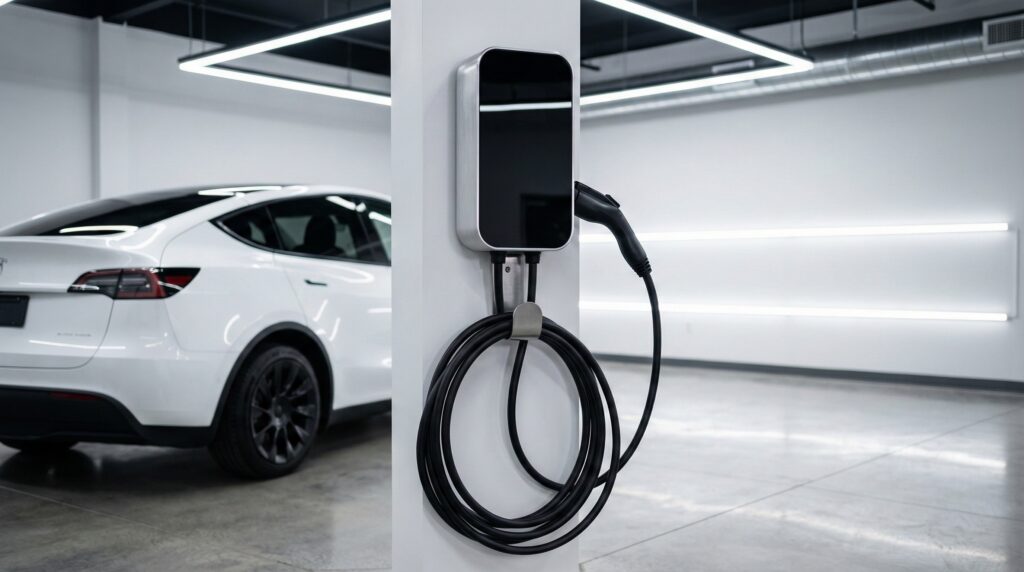
A “portable EV charger” is almost always a portable EVSE (Electric Vehicle Supply Equipment)—a device that safely delivers AC power from a wall outlet to your EV and communicates with the car so charging happens within safe limits. It’s easy to call it a “charger,” but the true charger (the part that converts AC power into DC to fill the battery) is built into your vehicle. The portable EVSE is basically the intelligent, safety-focused “gatekeeper” between the outlet and the car.
Most portable EV chargers fall into two practical buckets:
- Level 1 (120V): Plugs into a standard household outlet (typically NEMA 5-15). It’s widely available and great for travel contingencies, but it’s slow — often best for topping up overnight rather than refilling a large battery quickly.
- Level 2 (240V): Plugs into a 240V outlet (commonly NEMA 14-50 in garages, RV parks, and some workshops). It’s much faster than Level 1, but only if you have the right outlet and a circuit that’s properly installed and in good condition.
Charging speed is limited by three things working together: the outlet voltage (120V vs 240V), the EVSE’s current setting (amps), and your EV’s onboard charger limit. A higher-amp portable EVSE can’t force faster charging if your vehicle won’t accept it. That’s why “max amps” is only useful when it matches your wiring and your car.
You’ll also see battery-based “portable EV chargers” marketed as power banks. They can be useful in niche cases, but they’re typically heavy, expensive per mile of added range, and limited in stored energy. For most homeowners, a plug-in portable EVSE plus a little outlet planning is the more practical solution.
Finally, because portable charging often means plugging into unknown or older receptacles (at family homes, rentals, workshops, or campgrounds), safety certification and protections matter a lot. Look for a recognized safety listing (UL/ETL/NRTL; UL 2594 and UL 2231 are common EVSE-related standards) rather than vague “compliant” marketing. For background, the U.S. Department of Energy AFDC charging guide is a solid starting point, and electrical safety expectations are shaped by the NFPA National Electrical Code (NEC).
Who Portable EV Chargers Fit Best
Portable EV chargers are a great fit if you want charging flexibility beyond a single hardwired home station — especially when you expect to plug in at different locations with different outlet types.
They tend to work best for:
- Drivers who split time between home and travel (visiting family, second homes, rentals) and want a known-good EVSE they can trust.
- Homeowners with an existing 240V receptacle (like NEMA 14-50) who want a plug-in setup instead of installing a dedicated wall unit immediately.
- People who want a backup plan in the trunk/frunk in case public charging is busy or out of service.
- Households with more than one EV, where a portable EVSE can serve as a “float” charger for whichever car needs it.
From customer experience, reliability and simplicity are often what people value most in a portable unit. One verified buyer summed it up this way: “This charger works great and charges at a good fast rate (60% to 100% in about 3 hours).” — verified buyer, 5 stars.
That kind of feedback aligns with how most homeowners actually use portable EVSEs: they want something that plugs in, charges consistently, and doesn’t require fussing with settings every time.
Who Should Skip Portable EV Chargers
A portable EV charger isn’t the best choice for everyone. You may want to skip (or at least deprioritize) a portable EVSE if your situation calls for something more permanent, higher-powered, or more foolproof.
Consider skipping a portable EV charger if:
- You want the cleanest, most “set-and-forget” home setup. A professionally installed, hardwired Level 2 station can be more robust long-term, reduce plug/receptacle wear, and may offer better cable management.
- You don’t have access to a suitable outlet. If you’re hoping a portable charger will “make” Level 2 happen without a proper 240V circuit, you’ll be disappointed (and potentially create a safety issue).
- You routinely need maximum charging power and your use-case fits a dedicated circuit. In many homes, a portable plug-in approach can be limited by the receptacle/circuit and by the need to keep the plug and outlet in excellent condition.
- You’re counting on adapters and unknown wiring in older buildings. That’s where nuisance trips, overheating receptacles, or inconsistent performance can show up.
Portable charging can also be frustrating if you’re buying into a product mid-revision or relying on a model that’s been updated over time. One critical-ish homeowner report hints at that “version roulette” feeling: “Finally, they improved this charger.” — verified buyer, 4 stars. If you don’t want to worry about revisions, you may prefer a more established hardwired station installed by a licensed electrician (NEC-certified).
Price and Value
Most portable EV chargers (portable EVSE) cluster into a few price tiers:
- Level 1 (120V) portable EVSE: often the least expensive, but also the slowest and simplest.
- Portable Level 2 (240V) EVSE: typically mid-priced, with costs driven by amperage, cable quality/length, weather resistance, and whether current is adjustable.
- Battery-based “power bank” EV chargers: usually the most expensive per mile of added range and the heaviest to carry — more of a specialty backup than a mainstream solution.
For a mainstream portable Level 2 unit, you’ll commonly see prices in the mid-hundreds. For example, the Lectron Level 2 EV Charger 240V 40 Amp NEMA 14-50 Plug is typically listed around $250–$300. At that price, the value proposition is straightforward: if you already have (or routinely access) a NEMA 14-50 outlet on a properly installed circuit, a portable Level 2 EVSE can deliver meaningful overnight charging without committing to a permanently mounted station.
Where value can fall apart is when buyers spend Level 2 money but don’t actually have a compatible 240V outlet — or they buy a high-amp unit and then have to dial it back constantly because the wiring/outlet can’t safely support it. In other words: the EVSE is only half the purchase; the outlet and circuit are the other half. When in doubt, have a licensed electrician verify the receptacle type, breaker size, and wiring before you plan on regular Level 2 charging.
Common Mistakes When Trying Portable EV Chargers
Portable EV chargers are simple in concept, but the real-world mistakes we see usually come down to compatibility, circuit limits, and unrealistic expectations.
Common homeowner-reported pitfalls include:
- Buying the wrong connector for the car. Most non-Tesla EVs use J1772 for AC charging. Teslas use NACS, though many Tesla owners successfully use J1772 EVSEs with the correct adapter. The key is planning your adapter strategy before you’re stuck in a driveway 500 miles from home.
- Assuming any 240V outlet will work. “240V” isn’t one universal plug. NEMA 14-50 is common, but there are many other receptacle types. If the plug doesn’t match the outlet, don’t force it or rely on bargain adapters without understanding continuous-load ratings.
- Overestimating charging speed. Level 1 is slow; Level 2 is faster, but your EV’s onboard charger still sets a ceiling. Also, if you’re on a shared circuit (or an older receptacle), you may need to lower amperage.
- Ignoring heat at the outlet. Portable Level 2 charging can run for hours at high current. A worn receptacle, loose connections, or undersized wiring can overheat. If you ever notice a hot plug/outlet, stop and have it inspected.
- Using extension cords “just this once”. Unless the EVSE manufacturer explicitly allows it and the cord is properly rated for continuous current, extension cords can add heat and failure points.
Even when a unit is generally reliable, buyers often only feel confident after they see consistent performance. As one verified buyer put it: “This charger works great and charges at a good fast rate (60% to 100% in about 3 hours).” — verified buyer, 5 stars. The takeaway: once you’ve confirmed the outlet, the circuit, and the amperage setting are appropriate, portable charging can be very predictable — but the setup details matter.
For safety basics and charging-level expectations, it’s worth reviewing the U.S. Department of Energy AFDC EV charging overview. And if you’re installing or upgrading a receptacle/circuit for regular charging, the NFPA NEC is the governing code framework your electrician will follow.
FAQ
Will a portable EV charger work with my EV?
Usually, yes — if the connector and charging level match what your EV supports. For AC charging in the U.S., most non-Tesla vehicles use the SAE J1772 connector, while Tesla vehicles use NACS (and may use adapters for J1772). Also confirm you’re buying an AC EVSE (most portable units are) and not expecting DC fast charging. The U.S. Department of Energy AFDC charging guide explains the common charging levels and use cases.
How fast is a portable EV charger?
Speed depends on (1) Level 1 vs Level 2, (2) the EVSE amperage setting, and (3) your car’s onboard charger limit. Level 1 (120V) is typically a slow add over many hours; Level 2 (240V) is much faster when you have a properly rated circuit and outlet. If your EV can only accept a certain maximum AC rate, a higher-amp EVSE won’t exceed it.
Can I use a portable Level 2 charger on any 240V outlet?
No. The outlet must match the EVSE plug (for example, many portable Level 2 units use NEMA 14-50), and the circuit must be correctly installed and sized for continuous load. If you’re unsure about breaker size, wiring gauge, or receptacle condition, ask a licensed electrician (NEC-certified) to verify it. The relevant safety expectations come from the NFPA National Electrical Code (NEC).
What safety certification should I look for on a portable EV charger?
Look for a recognized safety listing from a Nationally Recognized Testing Laboratory (NRTL), commonly tied to EVSE standards like UL 2594 (EVSE) and UL 2231 (personnel protection systems). Certification helps indicate the unit has been evaluated for electrical safety features like ground-fault protection and safe operation under fault conditions. You can learn more about standards and testing via UL Solutions.
Is it safe to run a portable EV charger every night?
It can be safe if the EVSE is safety-listed, the amperage matches the circuit’s continuous-duty capacity, and the receptacle/wiring are in excellent condition. Where problems arise is repeated high-current use on worn or low-quality outlets, loose connections, or circuits not intended for sustained load. If you plan to charge nightly, many homeowners choose a dedicated circuit and have it evaluated/installed by a licensed electrician following the NFPA NEC.
Should I buy a battery-based “portable EV charger” instead of a plug-in EVSE?
For most drivers, no. Battery-based units are heavy, expensive per mile of added range, and limited by how much energy they can store. They can make sense if you truly expect to be without outlet access and you accept that you’re paying for a limited backup. For typical travel and emergency coverage, a plug-in portable EVSE plus planning is the more practical approach, as outlined in the U.S. Department of Energy AFDC charging overview.
Looking for these on Amazon? Browse portable ev charger on Amazon →
Bottom Line
A portable EV charger is worth it when you want flexible, outlet-based charging you can take anywhere — and when you choose the right connector, plug type, and a safe amperage for the circuits you’ll actually use. For most homeowners, a safety-certified portable Level 2 EVSE matched to a common 240V outlet (often NEMA 14-50) delivers the best balance of speed and practicality.
If you’re unsure about outlet condition, circuit sizing, or frequent high-amperage charging, it’s smart to involve a licensed electrician (NEC-certified) rather than gambling on adapters and assumptions.
Affiliate disclosure: We may earn affiliate commissions from qualifying purchases. This doesn't influence our reviews.