Quick Summary
Switching to a tankless gas water heater is often motivated by the promise of endless hot water and lower monthly utility bills. However, the transition involves more than just swapping out a white cylinder for a sleek wall-mounted box. While units from Navien and Rinnai offer incredible longevity and performance, they require a commitment to annual maintenance and a significant upfront investment—often ranging between $4,000 and $10,000 for professional installation. If your home has hard water, a softener is non-negotiable to prevent heat exchanger failure. For those in cold climates, sizing the unit based on “temperature rise” rather than just the number of bathrooms is the only way to avoid lukewarm showers in the winter.
The Top-Rated Gas Tankless Units
Choosing the right unit depends on your local climate and how many people are trying to shower at once. The market is currently led by a few heavy hitters that plumbers consistently recommend for their reliability and part availability.
Navien NPE-240S: The Professional’s Choice
The Navien NPE series is frequently the first recommendation from licensed plumbers. What sets it apart is its condensing technology, which captures extra heat from exhaust gases to achieve higher efficiency. The “S” stands for standard, while the “A” models include an integrated buffer tank and recirculation pump. This buffer tank is a specific fix for the “cold water sandwich”—that annoying burst of cold water that happens when you turn the tap off and back on quickly.
✅ What Homeowners Love
- No Cold Bursts: The internal buffer tank in the “A” series ensures consistent temperatures even during intermittent use.
- High Efficiency: Its condensing design means you can often use cheaper PVC venting rather than expensive stainless steel.
- Ease of Service: Navien’s customer support is widely regarded by technicians as the gold standard for troubleshooting.
❌ Watch Out For
- Installation Sensitivity: If the gas line isn’t sized perfectly (usually requiring a 3/4-inch line), the unit may struggle to ignite or throw error codes.
- Proprietary Parts: If a sensor fails, you likely won’t find a replacement at a local hardware store; you’ll be waiting for a plumbing supply house to open.
💼 The Verdict: Best for large families who need “instant” hot water and want to eliminate the cold water sandwich. Skip if you aren’t willing to upgrade your gas line to meet its high BTU demands.
Check Navien NPE Series Pricing
Rinnai RL Series: Best for Longevity
Rinnai has been the “Buy It For Life” darling of the tankless world for decades. The RL series consists of non-condensing units, which are slightly less efficient than condensing models but are known for being incredibly robust. Many plumbers point to Rinnai units still running strong after 20 years of service. They are the workhorses of the industry, often found in demanding commercial environments as well as residential homes.
✅ What Homeowners Love
- Proven Track Record: These units are famous for lasting two decades if maintained properly.
- Great for Retrofits: Because they are non-condensing, they can sometimes reuse existing venting in specific replacement scenarios.
- External Recirculation: Works beautifully with external pumps to get hot water to the furthest tap in seconds.
❌ Watch Out For
- Venting Costs: Non-condensing units require specialized, high-heat stainless steel venting, which can add hundreds of dollars to your installation bill.
- Lower GPM in Cold Areas: In northern states, you might find the flow rate drops significantly when the incoming groundwater is near freezing.
💼 The Verdict: Best for homeowners looking for a “set it and forget it” (with maintenance) long-term investment. Skip if you want the absolute highest energy efficiency rating available.
Find Rinnai RL Units on Amazon
Rheem Performance Platinum: Best for Accessibility
Rheem is the brand you’re most likely to find at a local big-box retailer. This makes them highly accessible for homeowners who need a replacement “today” rather than waiting for a specialty order. While they offer solid performance, the user experience on the service side can be a bit more mixed compared to the premium brands.
✅ What Homeowners Love
- Budget-Friendly: Often costs $300-$500 less than a comparable Navien or Rinnai unit.
- Availability: Parts and units are available at most major hardware stores.
- Smart Features: Many models come with EcoNet WiFi integration, allowing you to monitor usage and detect leaks from your phone.
❌ Watch Out For
- Quality Control: Some users report “Dead on Arrival” (DOA) units or early sensor failures within the first year.
- Warranty Support: Navigating Rheem’s warranty process can be more bureaucratic than the professional-grade brands.
💼 The Verdict: Best for DIY-inclined homeowners or those on a stricter budget who want modern features. Skip if you prefer the peace of mind that comes with a professional-exclusive brand.
Shop Rheem Performance Platinum
Takagi T-H3 Series: Best for Niche and In-Floor Heating
Takagi might not have the name recognition of Rheem, but in the world of specialized heating, they are highly respected. They were one of the first companies to specialize solely in tankless technology. The T-H3 is a condensing powerhouse often used not just for domestic hot water, but also for small-scale hydronic in-floor heating systems.
✅ What Homeowners Love
- Compact Design: Exceptionally small footprint, making it ideal for tight utility closets or “point-of-use” installs.
- Dual-Purpose: Excellent for homes that use their water heater for both showers and radiant floor heating.
- Sturdy Heat Exchanger: Built with commercial-grade copper alloys designed to withstand high stress.
❌ Watch Out For
- Niche Market: Finding a plumber who is specifically trained on Takagi might be harder in some rural areas.
- Limited Features: Often lacks the “flashy” WiFi apps found on Rheem or Rinnai units.
💼 The Verdict: Best for homes with radiant floor heating or very limited installation space. Skip if you want a mainstream brand with a massive local technician network.
Product Comparison Table
| Product Name | Best For | Price Range | Pros/Cons | Visit |
|---|---|---|---|---|
| The Professional’s Choice | large families who need “instant” hot water and want to eliminate the cold wa… | — | ✅ No Cold Bursts: The internal buffer tank in the “A; High Efficiency: Its condensing design means you c ❌ Installation Sensitivity: If the gas line isn’t si; Proprietary Parts: If a sensor fails, you likely w |
|
| Best for Longevity | homeowners looking for a “set it and forget it” (with maintenance) long-term … | — | ✅ Proven Track Record: These units are famous for la; Great for Retrofits: Because they are non-condensi ❌ Venting Costs: Non-condensing units require specia; Lower GPM in Cold Areas: In northern states, you m |
|
| Best for Accessibility | DIY-inclined homeowners or those on a stricter budget who want modern features | $300-$500 | ✅ Budget-Friendly: Often costs $300-$500 less than a; Availability: Parts and units are available at mos ❌ Quality Control: Some users report “Dead on Arriva; Warranty Support: Navigating Rheem’s warranty proc |
|
| Best for Niche and In-Floor Heating | homes with radiant floor heating or very limited installation space | — | ✅ Compact Design: Exceptionally small footprint, mak; Dual-Purpose: Excellent for homes that use their w ❌ Niche Market: Finding a plumber who is specificall; Limited Features: Often lacks the “flashy” WiFi ap |
What Real Users Are Saying (Reddit Insights)
General Sentiment: Endless Hot Water vs. High Upfront Costs
The consensus among the Reddit community is that a tankless unit is a luxury upgrade, not necessarily a money-saving one in the short term. While you will see your gas bill drop—often significantly—the initial $5,000 to $8,000 “plumber tax” for a proper installation means it could take over a decade to break even. Users frequently mention that the real value isn’t the savings, but the ability to take back-to-back showers without the water turning cold.
“If your 50 gallon water heater starts getting cold because your teenager has been in the shower for 30 minutes, GOOD. But if you have a family of five and everyone needs to get ready at once, tankless is the only way to survive.” — r/askaplumber
Top Complaints & Warnings
The most common warning involves water quality. Tankless units use a delicate heat exchanger with narrow passages. If you have hard water, scale will build up like “clogged arteries,” eventually causing the unit to overheat or crack.
“Hardness of about 25 killed a tankless water heater in well under a year by blocking it up entirely. If you have hard water, you will need a water softener before the water heater in order to not void the warranty.” — r/BuyItForLife
Another frequent complaint is the “Cold Water Sandwich.” This happens when you turn off the hot water for a minute and then turn it back on. A small slug of unheated water that was sitting in the pipes reaches you before the heater can fire up again. This is why many users now insist on units with internal buffer tanks or recirculation loops.
Budget Tips & Value Picks
Reddit users often suggest that for those on a budget, sticking with a high-quality 50-gallon tank like a Bradford White might be smarter than buying a “cheap” tankless unit. However, if you are committed to the upgrade, the Navien NPE series is the most cited “value pick” because it is easier for a DIYer or a standard plumber to vent with PVC, saving significantly on material costs.
Key Buying Factors: GPM, Climate, and Recirculation
Calculating GPM for Cold Climates (The ‘Chicago’ Test)
When you see a unit rated for “9.5 GPM,” that number is usually calculated based on warm groundwater in Florida. In cold climates like Chicago or New York, the incoming water might be 40°F. To get that water to a comfortable 120°F, the heater has to work much harder, which slashes the actual output. A unit rated for 9 GPM might only deliver 4.5 GPM in the winter—enough for maybe two showers at once, rather than four. Always size up if you live in the North.
If you are exploring more options for your home, our water heating systems hub covers everything from traditional tanks to modern high-efficiency units.
Why Recirculation Loops are No Longer Optional
One of the biggest frustrations with tankless units is the “wait time.” Since there is no hot water sitting in a tank, the unit has to sense flow, ignite the burner, and then push the water through the pipes. If your bathroom is 50 feet away, you might wait two minutes for hot water. A recirculation loop (like those found in the Navien NPE-240A2) keeps hot water moving through the pipes so it’s ready the moment you open the tap.
Installation & Maintenance: Can You Actually DIY?
The Cost of Professional Installation ($5,500 Average)
Most professional quotes for a tankless swap include more than just the box. Plumbers often have to:
- Upsize your gas line from 1/2-inch to 3/4-inch to provide enough “juice” for the high-BTU burners.
- Install a new intake and exhaust venting system through an exterior wall.
- Add a condensate neutralizer to protect your home’s plumbing from acidic drainage.
Expect to pay around $5,500 on average, though complex installs in high-cost-of-living areas can easily hit $10,000.
DIY Descaling: The $150 Kit That Saves You Thousands
The “maintenance tax” is real. If you pay a plumber to descale your unit every year, you’re looking at $300 per visit. However, you can buy a simple kit consisting of a 5-gallon bucket, a submersible pump, and two hoses. Running food-grade white vinegar through the unit for 60 to 90 minutes once a year will keep the heat exchanger clean and the warranty intact.
For more technical advice on maintaining your home’s infrastructure, check out our guide on the best tankless water heater options for different fuel types.
Tankless vs. Alternatives: Is Gas Still King?
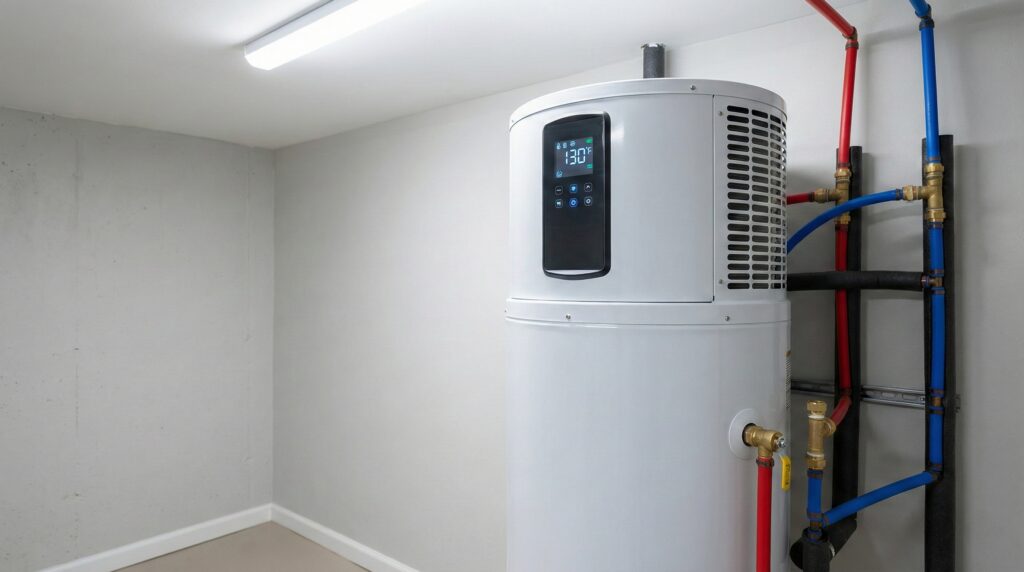
While gas tankless units are powerful, they aren’t the only option. Heat pump water heaters are gaining massive traction because they are incredibly efficient and can often be installed without running new gas lines. However, heat pumps still rely on a storage tank. If you truly need “endless” water for a family that takes five showers in a row, gas tankless is still the undisputed king.
If you’re looking to integrate your water heater with a wider smart home setup, you might also find our review of the best smart thermostat helpful for managing your home’s overall energy footprint. For a broader look at energy-efficient climate control, our heating and cooling solutions section offers deeper dives into modern HVAC technology.
Frequently Asked Questions
Is a tankless water heater worth the upgrade for a small family?
For a small family of two or three, the “endless hot water” benefit is less noticeable than for a large household. The primary advantage is the space saved by removing a bulky 50-gallon tank. However, unless your current tank is failing, the $5,000+ installation cost for a unit like the Rinnai RL series may not be financially “worth it” solely for energy savings, as it can take over a decade to recoup the initial investment.
How often do you actually need to descale a tankless unit?
Standard recommendation is once per year. However, if your water is exceptionally hard (over 12 grains), you might need to descale every six months. Neglecting this maintenance is the number one cause of premature failure in units like the Navien NPE-240S. You can perform this yourself with a $150 pump kit and white vinegar, which is much cheaper than a $300 professional service call.
Will a tankless gas heater work in freezing climates like Chicago?
Yes, but you must size the unit correctly. In Chicago, groundwater can drop to 40°F in winter. To reach 120°F, the heater needs an 80-degree “temperature rise.” This drastically reduces the gallons per minute (GPM) the unit can produce. A large unit like the Navien NPE-240S is highly recommended for cold climates because its high BTU output can still support two simultaneous showers even in the dead of winter.
Do I need a water softener to keep my tankless warranty valid?
In most cases, yes. Most manufacturers, including Rheem and Rinnai, include clauses in their warranties stating that the heat exchanger is not covered if failure is caused by scale buildup from hard water. If your water hardness exceeds 12 grains per gallon, installing a water softener is essential to protect your investment and ensure you don’t void the warranty on your new gas tankless system.
What is the real cost difference between a 50-gallon tank and tankless over 15 years?
A standard 50-gallon tank costs about $2,000 installed and requires almost zero maintenance for 12 years. A tankless unit costs $5,500 installed plus $300 annual maintenance (if professionally serviced), totaling roughly $10,000 over 15 years. While the tankless unit saves about $100-$150 annually in gas, the total cost of ownership is significantly higher. You are paying for the luxury of endless hot water and space savings, not purely for financial ROI.
Why do plumbers recommend Navien over other brands?
Plumbers favor Navien because their units are designed for easy installation and servicing. Features like the ability to use 2-inch PVC venting and a 1/2-inch gas line in some scenarios make them more “retrofit friendly.” Additionally, Navien’s technical support is highly responsive, helping technicians resolve issues quickly so they aren’t stuck on a job site. The integrated buffer tank in the A2 series also eliminates the “cold water sandwich,” leading to fewer customer complaints.
Final Thoughts
A tankless gas water heater is one of the most satisfying upgrades you can make to your home’s infrastructure, provided you go into it with clear eyes. It is not a “set it and forget it” appliance like the old tank in your basement. It requires annual care and a high-quality installation by someone who understands gas pressure and venting requirements. If you value the luxury of a long shower that never runs cold and you have the budget for the upfront costs, a Navien or Rinnai unit will serve your home beautifully for decades.
Disclosure: We earn a small commission on qualifying purchases through our Amazon links, at no extra cost to you. This helps us continue to provide honest, practical advice for your energy-efficient home.