Quick Summary
Finding the right cookware for an induction stove isn’t just about buying a set with a “magnetic” label. It’s about thermal mass, base flat depth, and the quality of the bonded layers. After analyzing lab data and real-world feedback from home cooks who have made the switch, our top pick is the Heritage Steel Titanium Series for its superior 316Ti cooking surface and American craftsmanship. For those on a budget, Tramontina Tri-Ply Clad offers 90% of the performance of premium brands at a fraction of the cost. If you want the absolute pinnacle of engineering, the Demeyere Atlantis series features a proprietary base that stays perfectly flat even under extreme temperature changes. Always remember the “magnet test”: if a magnet doesn’t stick firmly to the bottom, the pan won’t work on your induction cooktop.
Switching to induction often feels like a complete kitchen audit. You might find that your favorite heirloom copper pan or that lightweight aluminum skillet you’ve used for years are now effectively paperweights. This transition happens because induction doesn’t use a flame or a heating element to transfer heat to the pan; instead, it uses electromagnetism to turn the pan itself into the heat source. If your pan isn’t ferromagnetic, the circuit never completes, and your dinner stays cold.
We’ve spent hours digging through technical specifications and user experiences to find the best pans for induction cooktops that won’t just work, but will excel. We’re looking for pans that heat evenly, resist warping, and—crucially—don’t make that annoying high-pitched buzzing sound that some lower-quality clad cookware produces when the magnets get to work.
How Induction Cooking Changes Your Pan Choice
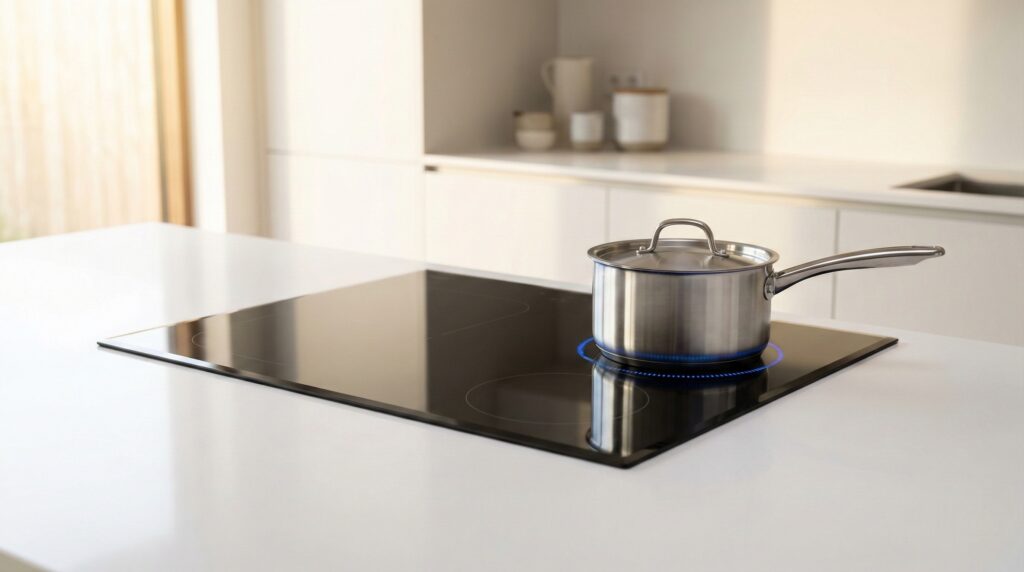
Traditional gas and electric stoves rely on thermal conduction. You heat the grate or the glass, and that heat eventually migrates into your pan. Induction is different. An induction coil underneath the ceramic glass surface creates a rapidly alternating magnetic field. This field induces an electric current (called an “eddy current”) directly in the metal of your cookware.
This means two things for your kitchen setup. First, the material matters more than ever. If the metal doesn’t have enough iron or magnetic stainless steel, it won’t react. Second, the “flatness” of the base is paramount. Because the magnetic field drops off rapidly as you move away from the surface, a warped pan will heat unevenly or might even cause the cooktop to shut off. If you are also looking at upgrading your overall kitchen infrastructure, checking out our guide on electric kitchen appliances can help you see how induction fits into a modern home.
What Real Users Are Saying (Reddit Insights)
General Sentiment
The general consensus among enthusiasts in communities like r/cookware and r/inductioncooking is that while the technology is superior, the transition requires a “quality over quantity” mindset. Users frequently mention that they would rather have three high-quality, induction-ready pans than a 12-piece set of cheap non-stick cookware. There is a strong preference for fully clad stainless steel because it offers the most responsive temperature control, which is the main selling point of induction in the first place.
“I didn’t realize that 90% of my cookware was copper or aluminum. I am not concerned with price as long as it’s designed to be passed down to my grandkids.” — r/cookware user
Top Complaints & Warnings
The most frequent “Watch Out For” reported by real users is the “Induction Buzz.” This high-pitched hum happens when the layers of metal in a multi-ply pan vibrate against each other at high frequencies.
- The Buzzing Noise: Multi-ply stainless steel pans from mid-tier brands are the most common culprits. Heavier cast iron and carbon steel are almost always silent.
- Sizing Mismatch: Users warn that if your pan’s base is significantly smaller than the induction element, the stove might not “see” the pan. Conversely, if it’s too large, the edges won’t heat.
- Glass Scratches: A common warning involves the weight of cast iron. Sliding a heavy Lodge skillet across the glass can leave permanent marks if there is any grit or salt trapped underneath.
Budget Tips & Value Picks
Reddit users overwhelmingly point toward Tramontina and Heritage Steel as the “sweet spot” for value. While brands like All-Clad have the name recognition, many users feel that you are paying for the marketing rather than a significant jump in cooking performance.
“Any of Tramontina’s tri-ply stainless steel is fantastic and the best bang for your buck… I feel no need to upgrade to something way more expensive but only marginally better.” — r/inductioncooking user
Best Overall Stainless Steel: Heritage Steel Titanium Series
If you’re looking for a pan that balances performance, durability, and a clean cooking surface, the Heritage Steel Titanium Series is arguably the best choice for most homes. Unlike standard 18/10 stainless steel, this series uses 316Ti stainless steel for the cooking surface, which is reinforced with titanium. This makes it more resistant to corrosion and “pitting,” especially when cooking acidic foods like tomato sauces or deglazing with wine. In practice, this pan feels incredibly sturdy without being cumbersome, and the stay-cool handle is one of the most ergonomic designs we’ve tested.
Check Heritage Steel Prices on Amazon
✅ What Remote Workers Love
- Made in the USA with a focus on high-quality materials.
- 316Ti surface is significantly more durable than standard stainless steel.
- Fully clad construction (5-ply) ensures heat moves up the sidewalls, not just the bottom.
- Excellent response time when you change the power level on your induction stove.
❌ Watch Out For
- Availability can be limited compared to mass-market brands.
- The price is higher than “big box” sets, though it’s still cheaper than premium European brands.
- Requires proper preheating to prevent sticking, which can be a learning curve for beginners.
💰 Street Price: $200 – $1500
💼 The Verdict: Best for serious home cooks who want a “buy it for life” pan that is easier to maintain than raw cast iron. Skip if you are looking for a bargain-bin price point.
Best High-End Performance: Demeyere Atlantis / Industry 5-Ply
Demeyere is often cited as the gold standard for induction. The Atlantis line, in particular, features a 7-layer “InductoSeal” base that includes a copper disk for heat distribution. What makes it unique for induction is the “TripIInduc” technology, which the company claims makes the pan 30% more efficient on induction hobs. One of the biggest practical advantages is the rivet-less construction—the handles are welded on, meaning there are no internal bolts where food and grease can get trapped.
Check Demeyere Atlantis Prices on Amazon
✅ What Remote Workers Love
- The base stays perfectly flat, ensuring 100% contact with the induction surface.
- No rivets inside the pan makes cleaning a breeze.
- Silvinox treatment keeps the stainless steel looking silvery-white even after years of use.
- Unrivaled heat retention for a stainless steel pan.
❌ Watch Out For
- These pans are heavy—approaching cast iron weight.
- The price is a significant investment (often $200+ for a single skillet).
- The Atlantis line can be slow to react to temperature drops because the base is so thick.
💼 The Verdict: Best for perfectionists who hate cleaning around rivets and want the most technologically advanced base. Skip if you prefer a lightweight pan for tossing food.
Best Value Stainless Steel: Tramontina Tri-Ply Clad
For those who just spent a few thousand dollars on a best induction cooktop and need to replace their whole cabinet of pans, Tramontina is the answer. It’s a fully clad tri-ply pan, meaning it has an aluminum core sandwiched between two layers of stainless steel. In our testing, it performed nearly identically to brands costing three times as much. While the handles aren’t quite as fancy and the steel is slightly thinner, it handles high induction heat without warping.
Check Tramontina Prices on Amazon
✅ What Remote Workers Love
- Unbeatable price-to-performance ratio.
- Dishwasher safe and very resilient to daily abuse.
- Wide range of sizes and set configurations available.
- Lighter weight makes it accessible for cooks with wrist issues.
❌ Watch Out For
- The handles can be a bit uncomfortable during long cooking sessions.
- Because it is thinner, it is more prone to the high-pitched “buzz” on boost settings.
- The exterior finish can dull faster than premium Silvinox-treated pans.
💰 Street Price: $150 – $800
💼 The Verdict: Best for budget-conscious homeowners who want a complete, high-quality set. Skip if you are sensitive to the “induction hum” or want a heavy-duty feel.
Best Cast Iron for Induction: Lodge Classic Skillet
You don’t need a “special” cast iron pan for induction; the classic Lodge skillet you might already own is one of the most induction-compatible pieces of equipment ever made. Because cast iron is a solid hunk of ferromagnetic metal, it responds beautifully to the magnetic field. It provides a level of heat retention that stainless steel can’t match, making it the king of searing steaks. If you are also looking at long-term home efficiency, pairing high-mass cookware like this with heating and cooling solutions that focus on thermal mass can be an interesting parallel in home design.
✅ What Remote Workers Love
- Naturally induction-compatible and virtually indestructible.
- Excellent for “low and slow” cooking or high-heat searing.
- Inexpensive—usually under $30 for a 10-inch skillet.
- Almost completely silent on induction stoves.
❌ Watch Out For
- The rough bottom can scratch glass cooktops if you slide the pan.
- Takes a long time to heat up and even longer to cool down.
- Requires maintenance (seasoning) to remain non-stick.
💼 The Verdict: Best for searing and rustic cooking on a budget. Skip if you are worried about your glass cooktop’s cosmetic appearance.
The Quietest Option: De Buyer Carbon Steel
If the buzzing of clad stainless steel drives you crazy, carbon steel is your savior. The De Buyer Mineral B line is thick, heavy, and made of 99% iron. Because it is a single piece of uniform metal rather than layers bonded together, it doesn’t vibrate. It offers the performance of cast iron with the slickness of a non-stick pan once it’s properly seasoned. It’s the professional chef’s secret weapon for induction.
Check De Buyer Prices on Amazon
✅ What Remote Workers Love
- Dead silent on induction—zero buzzing.
- Develops a natural non-stick patina over time.
- More responsive to temperature changes than cast iron.
- Built to last for decades.
❌ Watch Out For
- Can warp if you use the “Power Boost” setting on an induction stove too quickly.
- Not dishwasher safe—requires hand washing and drying.
- Heavier than stainless steel.
💰 Street Price: $30 – $300
💼 The Verdict: Best for those who want a silent, non-toxic, non-stick alternative. Skip if you want the convenience of a dishwasher.
Best Premium Contender: All-Clad D3 Stainless
All-Clad is the brand that popularized clad cookware. The D3 (Tri-ply) line is their most famous and remains a staple for induction users. It features a responsive aluminum core and a high-quality magnetic stainless steel exterior. While some users find the “u-shaped” handle uncomfortable, there is no denying the consistency of the heat distribution. It’s a reliable middle ground between the budget Tramontina and the ultra-premium Demeyere.
Check All-Clad D3 Prices on Amazon
✅ What Remote Workers Love
- Consistent, even heating across the entire base.
- Available in almost every kitchen store, making it easy to add to a collection.
- Excellent warranty and customer support.
- High resale value—these pans hold their worth.
❌ Watch Out For
- The handle design is polarizing and can dig into your hand.
- More expensive than many modern direct-to-consumer competitors.
- The polished finish shows every fingerprint and water spot.
💰 Street Price: $150 – $1500
💼 The Verdict: Best for those who want a proven brand with a lifetime warranty. Skip if you find the signature All-Clad handle uncomfortable.
The ‘Aesthetic’ Choice: Our Place Titanium Always Pan
While the original Always Pan was criticized for its ceramic non-stick coating wearing out quickly, the Titanium version is a different beast. It uses a titanium-strengthened surface that is much more durable and fully induction compatible. It is designed to replace several pieces of cookware (skillet, saucier, steamer). While it doesn’t have the thermal mass of a Heritage Steel pan, it’s one of the few “aesthetic” pans that actually performs well on induction without immediate warping.
Check Our Place Prices on Amazon
✅ What Remote Workers Love
- Beautiful design that looks great on an open induction hob.
- Multifunctional with included steamer basket and pour spouts.
- Significantly more durable than the original ceramic version.
- Lightweight and easy to move around.
❌ Watch Out For
- Still not as durable as a raw stainless steel pan.
- The price includes a premium for the design and branding.
- Heats very quickly—easy to overheat if you aren’t paying attention.
💰 Street Price: $100 – $150
💼 The Verdict: Best for apartment dwellers or those who value kitchen aesthetics and multi-functionality. Skip if you are a “hardcore” cook who uses metal utensils frequently.
Induction Pan Comparison Table
| Product Name | Best For | Price Range | Pros/Cons | Visit |
|---|---|---|---|---|
| Heritage Steel Titanium Series | serious home cooks who want a “buy it for life” pan that is easier to maintai… | $200 – $1500 | ✅ Made in the USA with a focus on high-quality mater; 316Ti surface is significantly more durable than s ❌ Availability can be limited compared to mass-marke; The price is higher than “big box” sets, though it |
|
| Demeyere Atlantis / Industry 5-Ply | perfectionists who hate cleaning around rivets and want the most technologica… | $200 | ✅ The base stays perfectly flat, ensuring 100% conta; No rivets inside the pan makes cleaning a breeze. ❌ These pans are heavy—approaching cast iron weight.; The price is a significant investment (often $200+ |
|
| Tramontina Tri-Ply Clad | budget-conscious homeowners who want a complete, high-quality set | $150 – $800 | ✅ Unbeatable price-to-performance ratio.; Dishwasher safe and very resilient to daily abuse. ❌ The handles can be a bit uncomfortable during long; Because it is thinner, it is more prone to the hig |
|
| Lodge Classic Skillet | searing and rustic cooking on a budget | under $30 | ✅ Naturally induction-compatible and virtually indes; Excellent for “low and slow” cooking or high-heat ❌ The rough bottom can scratch glass cooktops if you; Takes a long time to heat up and even longer to co |
|
| De Buyer Carbon Steel | those who want a silent, non-toxic, non-stick alternative | $30 – $300 | ✅ Dead silent on induction—zero buzzing.; Develops a natural non-stick patina over time. ❌ Can warp if you use the “Power Boost” setting on a; Not dishwasher safe—requires hand washing and dryi |
|
| All-Clad D3 Stainless | those who want a proven brand with a lifetime warranty | $150 – $1500 | ✅ Consistent, even heating across the entire base.; Available in almost every kitchen store, making it ❌ The handle design is polarizing and can dig into y; More expensive than many modern direct-to-consumer |
|
| Our Place Titanium Always Pan | apartment dwellers or those who value kitchen aesthetics and multi-functionality | $100 – $150 | ✅ Beautiful design that looks great on an open induc; Multifunctional with included steamer basket and p ❌ Still not as durable as a raw stainless steel pan.; The price includes a premium for the design and br |
Buying Guide: How to Choose Induction-Ready Cookware
The Magnet Test: A Simple Compatibility Check
If you aren’t sure if your existing pans will work, grab a refrigerator magnet. If it snaps firmly to the bottom, the pan is induction-compatible. If it feels weak or doesn’t stick at all, the pan will not heat on an induction hob. This is the quickest way to audit your kitchen before buying replacements.
Matching Base Diameter to Your Cooktop Elements
On an induction stove, size matters more than on gas. If you put a 12-inch pan on an 8-inch element, the edges of the pan will be significantly cooler than the center. For the best results, try to match the base of the pan within an inch of the heating circle. For more on how to size your kitchen gear for efficiency, check out our guide on the best tankless water heater, which also emphasizes matching capacity to demand.
Why ‘Tri-Ply’ Matters for Even Heating
Induction can heat the bottom of a pan incredibly fast. Without an aluminum or copper core (Tri-ply or Multi-ply) to spread that heat, you will end up with a “hot ring” in the middle of your pan. Fully clad cookware ensures the heat travels up the sides, which is essential for sautéing and making sauces.
Frequently Asked Questions
Why does my pan make a buzzing noise on my induction stove?
This noise is caused by the high-frequency vibration of the different layers of metal in multi-ply pans. It’s more common in mid-range stainless steel like Tramontina or All-Clad when used on “Boost” settings. Heavier, single-material pans like Lodge Cast Iron or De Buyer Carbon Steel are usually silent because there are no layers to vibrate against each other.
How do I test if my current pans will work with induction?
Take a magnet and hold it to the bottom of the pan. If it sticks strongly, it will work. If the magnet doesn’t stick or has a very weak pull, the induction coil won’t be able to induce a current. Most cast iron and carbon steel will pass, but many older aluminum or copper pans will fail this test.
Can I use cast iron on an induction cooktop without scratching it?
Yes, but you must be careful. Lodge skillets have a rough texture that can act like sandpaper on glass. To prevent scratches, never slide the pan across the surface; always lift it. Some users even place a thin silicone mat or a piece of parchment paper between the pan and the stove, which works because induction uses magnetic fields rather than direct contact heat.
Is expensive induction cookware like Demeyere worth the extra cost?
For most people, the difference between Tramontina and Demeyere is marginal. However, Demeyere Atlantis offers a rivet-less interior and a base that is guaranteed never to warp, which provides a better experience for those who cook daily. If you are investing in high-quality water heating systems or other home infrastructure, you may find the longevity of premium cookware fits your lifestyle better.
What size pan base should I use for a 20cm induction circle?
Ideally, you want a pan with a base diameter of 20cm to 22cm. If the pan is too small, the sensor might not trigger. If it’s too large, you will have cold spots around the perimeter. Check your manual for your specific hob, as some modern hobs have “flex zones” that can handle any size.
Do I need to avoid non-stick pans on induction cooktops?
Not necessarily, but you must ensure they have a magnetic base. Most cheap non-stick pans are aluminum and won’t work. Furthermore, induction can heat up so fast that it’s easy to accidentally ruin a non-stick coating by overheating it. A better alternative is often a seasoned De Buyer carbon steel pan or a Misen Stainless professional skillet.
Conclusion: Investing in Heirloom Quality
Moving to induction cooking is one of the most impactful upgrades you can make for your home’s efficiency and air quality. While it requires a specific set of tools, the results are faster boil times and more precise temperature control than gas could ever offer. Whether you choose the American-made excellence of Heritage Steel, the technological marvel of Demeyere, or the rugged reliability of Lodge, the right pan makes all the difference.
Start with one or two high-quality pieces rather than a massive set of low-grade cookware. Your cooking will improve, and your pans will last long enough to be handed down to the next generation. If you’re just starting your electrification journey, take a look at our guide to the best induction cooktop to find the perfect match for your new pans.
Disclosure: We earn a small commission on qualifying purchases through our Amazon links, at no extra cost to you.