TL;DR
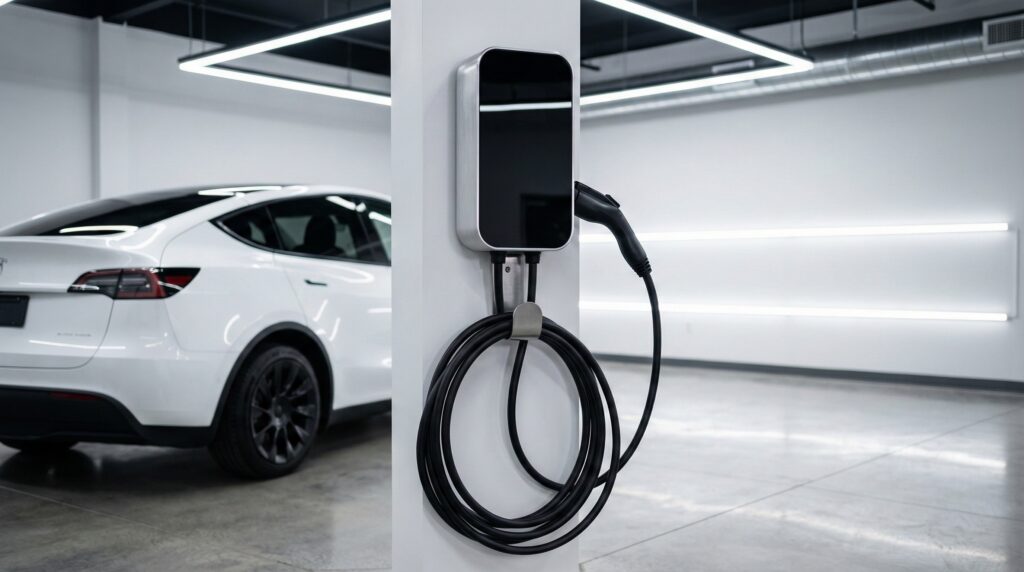
The best Level 2 home EV charger is the one that matches your car’s connector (J1772 or NACS/J3400) and your home’s electrical capacity, then delivers reliable day-to-day charging without drama. For most homeowners, we’d prioritize a reputable, safety-listed unit sized correctly to your breaker using the NEC continuous-load rule, and we’d strongly consider a hardwired install for long-term reliability.
Top Recommended EV Charging
| Product | Best For | Price | Pros/Cons | Visit |
|---|---|---|---|---|
| ChargePoint Home Flex | Most households wanting a polished app | — | Strong everyday usability and scheduling; buyer sentiment on brand support is mixed depending on where you look | Visit ChargePoint |
| Grizzl-E 48A Level 2 EV Charger J1772 Hardwired | Simple, tough hardwired J1772 installs | Check price on Amazon | High-output hardwired charging in a rugged style; fewer “smart” features and some reports of quirks over time | Visit Amazon |
Top Pick: Best Overall EV Charging
ChargePoint Home Flex
Best for: homeowners who want a well-known Level 2 charger with a mature app experience and scheduling — especially in a typical two-car garage where you’ll charge nightly and want off-peak automation.
The Good
- Strong day-to-day usability: homeowner reports frequently point to an easy setup flow and a “just works” feel once installed.
- Useful smart features for many households, including scheduling for time-of-use rates and basic energy/cost visibility (feature availability can vary by utility and setup).
- Flexible fit for different electrical realities: commonly installed as a hardwired unit, which many electricians prefer for fewer failure points than a receptacle.
- A mainstream pick that’s widely discussed among EV owners, which can make troubleshooting and installer familiarity easier.
The Bad
- We’re not using third-party lab specs here (amps, kW, enclosure rating) because we don’t have a manufacturer spec sheet in the provided data — so treat any listing claims you see elsewhere as “verify before you buy.”
- Brand-level review sites can skew negative because they capture support complaints; don’t confuse that with “the hardware is unsafe,” but do go in with realistic expectations about customer service.
- Like most smart chargers, your experience can depend on Wi-Fi strength in the garage; if your signal is weak, plan on adding a mesh node.
1.2/5 across 356 Trustpilot reviews (source)
“I previously had a juicebox, before recently getting the charge point home flex. I HIGHLY recommend the charge point. It’s super super easy to set up and use, and nice to have the app tell me exactly how much it’s costing me.” — r/evcharging discussion
“I went with this ChargePoint instead of teh usual fan favorite Emporia. No complaints so far.” — r/evcharging discussion
Our Take: If you want one Level 2 charger that most households will find easy to live with, ChargePoint Home Flex is the safest “default” recommendation — just have a licensed electrician size and install it correctly for your panel and circuit.
Grizzl-E 48A Level 2 EV Charger J1772 Hardwired
Best for: a straightforward hardwired install on a 60A-capable circuit in a garage or carport where you want J1772 compatibility and don’t care much about app bells and whistles.
The Good
- High-output option: marketed as a 48A hardwired Level 2 charger (typical pairing is a 60A branch circuit using the NEC continuous-load rule).
- J1772 connector makes it a natural fit for most non-Tesla EVs without needing an adapter.
- Hardwired format can be more “set it and forget it” than plug-in 14-50 setups because there’s no receptacle to loosen or heat-cycle over time.
- Solid Amazon buyer volume for this specific listing (4.3/5 across 300 Amazon reviews), which at least indicates it’s a commonly purchased option.
The Bad
- The provided buyer-review signals include a small but notable theme around “summer,” which can be consistent with heat-related complaints in some installs (often exacerbated by termination quality and enclosure exposure).
- Limited visibility here into smart features (scheduling, energy tracking, utility integrations) — verify in the listing and be realistic if you’re expecting robust app control.
- Because it’s hardwired, it’s less portable than a plug-in charger if you move — and you should plan on an electrician for install/removal.
4.3/5 across 300 Amazon reviews
“I have an EV, not a plug-in hybrid. It came with a charging cable. I was thinking about just having a dedicated 240-volt outlet installed until I found out that I could only charge at a maximum of 40 amps (80% of a 50-amp circuit breaker max for an outlet) rather than my car’s maximum and fastest 48 amps. Plus, the electrician informed me about some outlet…” — Verified Amazon buyer (5 stars)
“Update Feb 7, 2026I bought the charger because it has a metal enclosure and unfortunately, I needed to mount mine on a south facing wall. It will be baked in the hot Arizona sun all summer. I also wanted something NOT made in China. In those respects, I am happy with the charger. That is the end of my joy however.I absolutely hate the app! Where I live, my…” — Verified Amazon buyer (1 stars)
Our Take: If you want a simpler, high-amp J1772 hardwired charger and you’re already planning a proper electrician install, Grizzl-E’s 48A hardwired model is a reasonable short list candidate — but don’t buy it expecting the most refined “smart” experience.
FAQ
What amperage should I buy for a Level 2 home EV charger (32A vs 40A vs 48A)?
Start with your electrical capacity and the NEC continuous-load rule: EV charging is typically treated as a continuous load, so the charger’s output current should be no more than about 80% of the breaker rating. In plain terms, 32A pairs with a 40A circuit, 40A pairs with a 50A circuit, and 48A generally calls for a 60A circuit (often hardwired). For code and safety details, your electrician will reference NFPA 70 (NEC), Article 625.
Is hardwired better than plug-in (NEMA 14-50) for a home EV charger?
Often, yes: hardwired installs remove the receptacle as a potential heat/arc failure point and can be simpler for code compliance in many jurisdictions. Plug-in can make sense for portability (or if you already have a correctly installed 14-50 circuit), but it needs the right receptacle quality and may require GFCI protection depending on local code. When in doubt, have a licensed electrician (NEC-certified) evaluate your panel capacity and the best install approach.
Should I choose J1772 or NACS/J3400 for my home charger?
Choose the connector that matches your car most of the time. J1772 fits most non-Tesla EVs today, while NACS/J3400 is standard on Tesla and increasingly adopted by other automakers; adapters can bridge the gap, but they add a step every time you plug in. If you’re a mixed-connector household, think about which car will “own” the charger location and whether you’re comfortable using an adapter daily.
How long of an EV charging cable do I need for a garage or driveway?
Measure from the mounting spot to your car’s charge port along the path the cable will actually take (around shelves, across a garage door track area, etc.), then add slack so you’re not pulling tight. Many homeowners prefer a 25-foot cable because it covers more parking scenarios, including backing in or charging in a driveway, but extra length can be heavier to manage. Also consider where you’ll store the cable (holster and cord wrap) so it doesn’t become a daily annoyance.
Do smart features actually save money on home charging?
They can — mainly through reliable scheduling that shifts charging into off-peak hours if your utility uses time-of-use rates. Beyond that, energy monitoring and cost estimates are “nice to have,” but app reliability matters more than fancy graphs. If you have flat-rate electricity or unreliable Wi-Fi in the garage, a simpler charger can be the better experience.
What safety certifications should I look for on a Level 2 EV charger?
Look for a charger that is UL Listed / certified to appropriate EVSE safety standards (commonly UL 2594, and personnel protection aspects are commonly addressed under UL 2231). This doesn’t guarantee perfection, but it’s a meaningful baseline for reducing shock and fire risk compared with unlisted equipment. Pair that with a correctly sized circuit and professional installation — the install quality matters as much as the box on the wall.
Do I need a permit or electrician to install a Level 2 EV charger at home?
In most cases, yes — especially for a new 240V circuit or a hardwired EVSE. Permitting and inspection help catch issues like undersized wire, incorrect breaker choice, or poor terminations that can overheat under continuous load. A licensed electrician will also help confirm whether your panel can support 40A–48A charging or whether you should dial the charger down to a lower current setting.
Bottom Line
For most homes, the best pick is the ChargePoint Home Flex because homeowner reports consistently highlight easy setup and a useful app for scheduling and cost visibility — the stuff that affects every single charging session. If you want a simpler hardwired, high-output J1772 option and you’re already committing to a proper 60A-capable install, the Grizzl-E 48A hardwired model is also worth considering.
Affiliate disclosure: We may earn affiliate commissions from qualifying purchases. This doesn't influence our reviews.