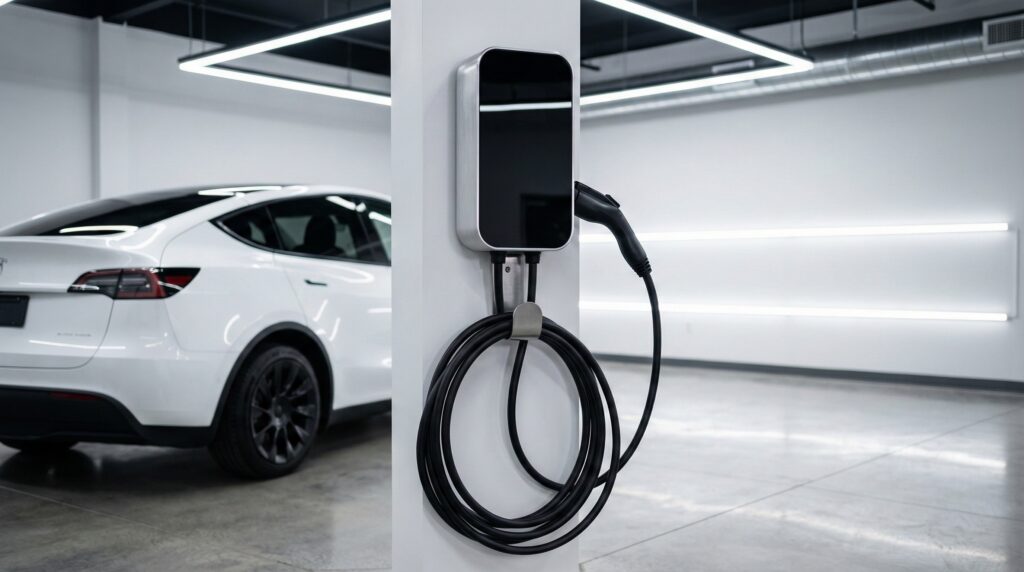
Quick Summary
- Top Performance: The Emporia Level 2 Charger offers the highest power output (11.5 kW) at one of the lowest price points in the market.
- Extreme Durability: For those in snowy or coastal regions, the Canadian-made GrizzlE Classic features a heavy-duty aluminum enclosure that outperforms plastic rivals.
- Smart Energy Management: The Wallbox Pulsar Plus is the preferred choice for homes with solar panels or limited electrical panel capacity.
- Tesla Standard: The Tesla Wall Connector remains the gold standard for NACS-equipped vehicles, offering seamless app integration and sleek aesthetics.
After researching and comparing dozens of home electrification products across heating, cooling, and energy efficiency categories, I’ve found that your choice of EV charger often dictates how smoothly your entire home energy transition goes. Switching to an electric vehicle is a massive step toward a more sustainable lifestyle, but the “fueling” part of the equation requires a bit of homework. I have spent years helping homeowners navigate these upgrades, and I’ve seen firsthand how a poorly chosen charger can lead to expensive panel upgrades or frustrating software glitches.
Your home’s electrical system has a finite capacity. Adding a high-draw appliance like a Level 2 charger can sometimes push an older 100-amp panel to its limit. If you are also looking into other home appliances that draw significant power, like induction ranges, balancing that load becomes critical. In this guide, I’ve curated the top Level 2 chargers based on real-world reliability, ease of installation, and community feedback from long-term owners.
Our Top Picks at a Glance
| Product Name | Best For | Price Range | Pros/Cons | Visit |
|---|---|---|---|---|
| Emporia Pro | Value & Energy Monitoring | $399 – $450 | + 48A Charging – Complex App |
|
| Tesla Wall Connector | Tesla Owners & Ecosystem | $450 – $500 | + Slim Profile – Hardwire Only |
|
| GrizzlE Classic | Cold Climates & Durability | $349 – $399 | + Metal Housing – No Smart Features |
|
| Wallbox Pulsar Plus | Solar & Load Balancing | $599 – $649 | + Very Compact – Short Cable Option |
|
| ChargePoint Home Flex | Premium Reliability | $549 – $599 | + Swappable Cables – Bulky Design |
|
| Flo G5 | Lifelong Build Quality | $800 – $950 | + Tank-like Build – Very Expensive |
|
| Lectron Portable Wi-Fi | Budget Connected Charging | $280 – $340 | + Low Entry Cost – Limited History Data |
Best Overall Level 2 Charger: Emporia Pro
The Emporia Pro has quickly become a favorite in the electrification community for one simple reason: it offers 48-amp charging capabilities at a price that usually only buys you 32 or 40 amps. When hardwired to a 60-amp circuit, this unit can deliver up to 11.5 kW of power, which is the maximum most modern EVs can accept. I’ve found that homeowners who already track their usage with the Emporia Vue 3 energy monitor appreciate the unified interface, though the app itself is quite dense with data.
Emporia Pro
✅ What Users Love
- Panel Management: Can integrate with Emporia’s energy monitor to automatically lower charging speed if your total home draw gets too high, potentially saving you thousands on a panel upgrade.
- Cable Quality: The 24-foot cable remains surprisingly flexible in cool weather, making it easier to maneuver around the garage.
- UL Listed: Unlike many budget-tier chargers, this is fully safety certified for peace of mind.
❌ Watch Out For
- App Complexity: The software is designed for energy enthusiasts. If you just want a simple “start/stop” button, you might find the charts and settings overwhelming.
- Bulkier Design: It isn’t the most aesthetically pleasing unit, featuring a somewhat industrial plastic look compared to Tesla or Wallbox.
💼 The Verdict: Best for tech-savvy homeowners who want the most power for their dollar and plan to monitor their whole-home energy footprint. Skip if you want a minimalist app experience.
Best for Tesla & Ecosystem Integration: Tesla Wall Connector (Gen 3)
If you drive a Tesla, the Gen 3 Wall Connector is the path of least resistance. It looks like a piece of modern art on your garage wall and features the proprietary NACS plug that clicks perfectly into your car. In practice, the auto-opening charge port feature (triggered by a button on the handle) is one of those small conveniences that makes daily life just a bit easier. It’s also remarkably thin, sitting closer to the wall than almost any competitor.
Tesla Wall Connector
✅ What Users Love
- Seamless Integration: Controls for the charger live right inside the Tesla app alongside your vehicle controls.
- Load Sharing: You can link up to six Wall Connectors on a single circuit, and they will intelligently talk to each other to balance the load between multiple cars.
- Reliability: Users consistently report high uptime and very few software “handshake” issues with Tesla vehicles.
❌ Watch Out For
- Hardwire Only: There is no plug-and-play NEMA 14-50 version of the Gen 3 connector; you must hire an electrician to hardwire it.
- Commissioning Hurdles: Setup requires connecting to the unit’s internal Wi-Fi via the Tesla One app, which can be finicky if your home Wi-Fi signal is weak in the garage.
💼 The Verdict: Best for Tesla households and those planning a multi-EV future. Skip if you need a portable or plug-in solution for a rental property.
Best for Cold Climates & Durability: GrizzlE Classic
Manufactured in Canada, the GrizzlE Classic is built like a tank. While other manufacturers use plastic for their enclosures, GrizzlE uses heavy-duty cast aluminum. This makes it the go-to recommendation on Reddit for anyone living in regions where winter temperatures drop well below zero. It doesn’t have Wi-Fi, it doesn’t have an app, and it doesn’t have a screen. For many, that lack of “smart” features is actually its biggest selling point—there are simply fewer parts to break.
GrizzlE Classic
✅ What Users Love
- Indestructible Build: The aluminum casing is NEMA 4 rated, meaning it’s protected against windblown dust, rain, and ice.
- Internal Adjustability: You can set the maximum amperage (16A, 24A, 32A, or 40A) using internal physical DIP switches, ensuring it works safely with your existing wiring.
- Exceptional Cable: The “Premium” cable option is specifically designed to remain flexible at -22°F (-30°C).
❌ Watch Out For
- No Connectivity: You cannot track energy costs or schedule charging via an app. You must rely on your vehicle’s onboard software for scheduling.
- Tight Wiring: Electricians sometimes complain that the internal space is cramped, making the initial hardwiring process a bit tedious.
💼 The Verdict: Best for outdoor installations in harsh climates or owners who want a “buy it once and forget it” appliance. Skip if you need to track your energy costs for tax or reimbursement purposes.
Best for Smart Features and Solar: Wallbox Pulsar Plus
The Wallbox Pulsar Plus is roughly the size of a lunchbox, making it the most compact 48-amp charger on the list. But don’t let the size fool you—it’s packed with high-end features. It is one of the few chargers that offers “Eco-Smart” solar charging, allowing you to direct excess power from your solar array directly into your car instead of back to the grid. This level of control is a significant step forward in optimizing your EV charging equipment setup.
Wallbox Pulsar Plus
✅ What Users Love
- Solar Integration: Can be configured to charge only when your solar panels are producing surplus energy.
- Bluetooth Backup: Most smart chargers rely on Wi-Fi, but the Wallbox also has Bluetooth. If your Wi-Fi goes down, you can still control the charger from your driveway.
- Dynamic Load Management: Pairs with a power meter to adjust charging speeds based on real-time home energy use.
❌ Watch Out For
- Cable Length: Ensure you select the 25-foot version; the shorter 16-foot cable often leaves users parked in awkward positions to reach the port.
- Halo Light: The LED ring is bright. If it’s installed near a bedroom window, the “standby” glow can be annoying at night.
💼 The Verdict: Best for homes with solar panels or tight garage spaces. Skip if you prefer a simplified, non-connected device.
Best Premium/Reliability Option: ChargePoint Home Flex
ChargePoint is a massive name in public charging, and they brought that commercial-grade expertise to the Home Flex. It’s a versatile unit that works with both NEMA 14-50 plugs and hardwired installations. One of the unique features is the swappable cable; if your cable gets damaged or you switch from a J1772 car to a NACS car in the future, you can replace just the cable rather than the whole unit. We explored similar long-term reliability in our best home ev charger analysis, where ChargePoint consistently ranked high for app stability.
ChargePoint Home Flex
✅ What Users Love
- App Ecosystem: The app is polished and provides excellent data on how much you are saving compared to gas prices in your specific zip code.
- Flexible Amperage: Supports anything from 16 to 50 amps (on a 70-amp circuit), making it future-proof for high-power vehicles.
- Build Quality: The unit feels substantial, and the holster design makes it easy to stow the cable tidily.
❌ Watch Out For
- Price Premium: You are definitely paying for the brand name and the swappable cable feature.
- Physical Size: It takes up a fair amount of wall real estate compared to the slim Tesla or Wallbox units.
💼 The Verdict: Best for those who want a premium, “brand name” experience with the security of a long-standing company. Skip if you are on a tight budget.
Best for Long-Term Durability: Flo G5
In the world of EV charging, the Flo G5 is often called the “King of the Mountain.” It is designed and manufactured in Quebec to withstand some of the most brutal winters on Earth. While it doesn’t have the fancy Wi-Fi graphs of the Emporia or Wallbox, it is built to last 20+ years. The casing is high-grade aluminum, and the cable is industrial strength. If you are looking to upgrade other systems, like water heating systems, you know that build quality often beats fancy features in the long run.
Flo G5
✅ What Users Love
- Cold Weather Performance: The cable remains flexible even at -40°C, a feat few other chargers can match.
- Elegant Simplicity: No buttons, no screens, just a high-quality plug that works every single time.
- Safety: Extremely robust internal components that handle power surges better than cheaper plastic units.
❌ Watch Out For
- The Cost: As one Reddit user put it, you might need a “second mortgage” to afford one. It is significantly more expensive than the Emporia or Tesla options.
- No Smart Features: There is no app connectivity for the G5 model (the X5 has limited smarts), so you can’t track energy usage easily.
💼 The Verdict: Best for those living in extreme climates who prioritize absolute reliability over software features. Skip if you are budget-conscious.
Best Budget-Friendly Smart Charger: Lectron Portable Wi-Fi
The Lectron Portable unit is a unique hybrid. It can be used as a permanent home station or tossed in the trunk for road trips. Despite its low price, it includes Wi-Fi connectivity, allowing you to monitor your charge status and set schedules from your phone. It’s a great entry point for someone who isn’t sure they want to commit to a permanent $600 installation yet.
Lectron Portable Wi-Fi
✅ What Users Love
- Versatility: Works as both a home charger and a travel charger.
- Built-in Screen: The small LCD provides real-time data on voltage, amperage, and total kWh delivered without needing to open an app.
- Price: Hard to beat for a 40-amp unit that includes smart features.
❌ Watch Out For
- Software Limits: Users report the app only stores 30 days of charging history, which is frustrating if you’re trying to track annual costs.
- Durability Concerns: Being a portable unit, the casing isn’t as robust as a dedicated wall station, and long-term weather sealing is not as proven as GrizzlE or Flo.
💼 The Verdict: Best for budget-minded owners or those who frequently travel to places with NEMA 14-50 outlets. Skip for permanent outdoor installations.
What Real Users Are Saying (Reddit Insights)
General Sentiment
The consensus in the r/evcharging and r/electricvehicles communities is a strong lean toward “dumb” reliability or high-value smart units. Most users emphasize that while apps are fun for the first two weeks, a charger’s primary job is to deliver power without failing. Brands like GrizzlE and Tesla get the most consistent praise for uptime, while Emporia is the clear winner for those focused on the “best bang for the buck.”
Top Complaints & Warnings
A recurring theme in forums is frustration with software-heavy chargers that lose Wi-Fi connectivity. When the “smart” features fail, some chargers struggle to initiate a charge.
“Emporia’s app is great for data nerds, but I’ve had times where it felt unnecessarily complex just to change the amperage.” — Reddit User
“I went with the ChargePoint Home Flex because my utility gave me a rebate, but the unit is huge on the wall compared to my neighbor’s Tesla charger.” — Reddit User
Other complaints include the “Tesla tax” (though the Universal Wall Connector has solved some of the compatibility issues) and the high entry cost of Canadian units like Flo.
Budget Tips & Value Picks
Community members frequently suggest checking for local utility rebates before buying. Some power companies will actually give you a free charger if you agree to let them throttle your charging during peak demand hours.
“Don’t let that grant money dry up. My state had a puddle of money for EVSEs but it all got distributed before I even started thinking about an EV.” — r/evcharging
For pure value, the Emporia refurbished units or the base GrizzlE are the top community recommendations for staying under $400 while still getting a safe, UL-listed product.
Other Notable Alternatives Worth Considering
If the main picks don’t quite fit your needs, the Tesla Universal Wall Connector is an excellent choice for households with both a Tesla and a non-Tesla EV, as it has a built-in J1772 adapter. The EVIQO Evipower Gen2 is another rising star in the budget space, offering 48-amp charging and a sleek app for a competitive price. For those who want the classic GrizzlE durability but with some smart features, the GrizzlE Smart adds Wi-Fi connectivity to their legendary aluminum frame.
Best EV Chargers by Use Case
Best for Avoidance of Panel Upgrades
The Emporia Pro paired with the Emporia Vue 3 Energy Monitor is the champion here. By monitoring the total load on your electrical panel, the system can automatically throttle the car charger to ensure you never exceed your home’s total capacity. This setup is a significant improvement over traditional installations that require a massive service upgrade. We saw similar energy-saving logic in our review of the best level 2 ev charger options for older homes.
Best for Solar Users
The Wallbox Pulsar Plus is the most intuitive for solar integration. Its ability to communicate with a power meter at the main service entrance allows it to “see” when you have excess solar production and ramp up the charging speed accordingly. It’s the closest thing to “driving on sunshine” that you can get with current hardware.
Best for Extreme Cold
The Flo G5 and GrizzlE Classic share this crown. In climates like Quebec or Minnesota, a plastic cable will turn into a stiff, unmanageable rod in January. These units use specialized rubber and internal heaters to ensure the cable stays flexible and the electronics stay functional in the deep freeze.
Buyer’s Guide: NACS vs. J1772 and Amperage Needs
Choosing the right connector is simpler than it used to be. Most new cars in North America are moving toward the NACS (Tesla) standard. However, many current EVs still use the J1772 plug. If you buy a J1772 charger today, you can easily use an adapter for a Tesla, and vice versa. The bigger decision is amperage. In 2026, most new homes will likely come with 50 or 60-amp dedicated circuits for EVs. To get the maximum 48-amp charging speed, you must hardwire the unit to a 60-amp circuit. If you use a NEMA 14-50 plug, you are limited to 40 amps by electrical code.
I generally recommend hardwiring whenever possible. It eliminates a common point of failure (the outlet itself) and allows for higher charging speeds. If you are also considering other home improvements, like heating and cooling upgrades, talk to your electrician about a holistic load calculation for your entire home.
Frequently Asked Questions
Do I need to upgrade my electrical panel to install a Level 2 charger?
Not necessarily. While a 200-amp panel is ideal, smart chargers like the Wallbox Pulsar Plus or Emporia Pro can use dynamic load management to stay within the limits of a 100-amp panel. By monitoring your home’s total draw, these units throttle the charging speed when you’re using heavy appliances like the dryer or stove, avoiding a costly panel upgrade.
Is it better to hardwire a charger or use a NEMA 14-50 plug?
Hardwiring is generally superior for permanent installations. It allows for higher amperage (48A vs 40A), is more weather-resistant for outdoor use, and removes the risk of “melted” outlets—a common issue with budget-grade NEMA 14-50 receptacles. Units like the Tesla Wall Connector are hardwire-only for these reasons, though a plug is useful if you are a renter and need to take the unit with you.
What is the best EV charger for cold Canadian winters?
The Flo G5 and GrizzlE Classic are the top choices for extreme cold. Both are Canadian-made and feature heavy-duty aluminum enclosures and high-quality cables that remain flexible at -40°C. Cheaper plastic chargers can become brittle, and their cables can become impossible to coil in the deep freeze, making these robust options well worth the investment.
Can I use a Tesla Wall Connector with a non-Tesla EV?
Yes, but you will need an adapter. The Tesla Wall Connector uses the NACS plug, while most non-Tesla EVs in North America currently use J1772. You can buy a separate adapter or opt for the Tesla Universal Wall Connector, which has a J1772 adapter integrated directly into the holster for maximum convenience.
Are there government rebates available for home EV charger installation?
Yes, many federal, state, and local utility programs offer incentives. In the U.S., the federal tax credit can cover up to 30% of the cost of the hardware and installation. Many utilities also offer “time-of-use” rebates if you use a smart charger like ChargePoint Home Flex to charge during off-peak hours. Always check your local utility website before purchasing to maximize your savings.
Final Thoughts
The right Level 2 charger isn’t necessarily the most expensive one; it’s the one that fits your home’s electrical capacity and your local climate. If you want the best value and whole-home monitoring, the Emporia Pro is hard to beat. If you live in a region with brutal winters, the GrizzlE Classic or Flo G5 will serve you best. For Tesla owners, the Wall Connector remains the most polished choice. No matter which you choose, hardwiring is the safest and most efficient way to fuel your new electric life.
Disclosure: We earn a small commission on qualifying purchases through our Amazon links, at no extra cost to you.