Quick Summary
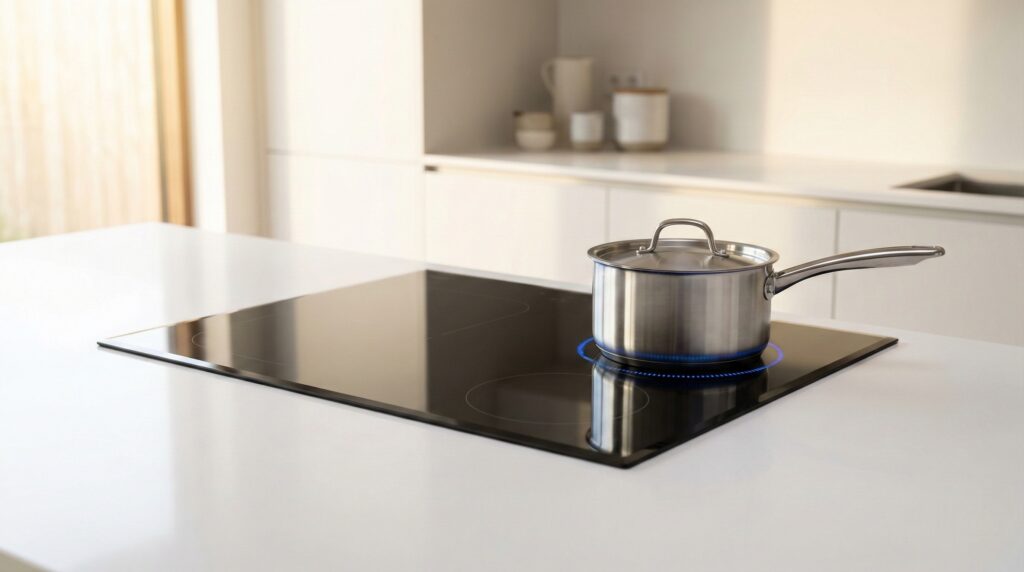
Induction cooking is no longer a futuristic luxury; it is the most efficient way to upgrade your kitchen. Unlike traditional electric coils, induction uses electromagnetism to heat your pans directly, leaving the glass surface cool to the touch and your kitchen free of that “sauna” feeling. The top-rated models right now prioritize physical control knobs and larger heating elements to prevent the “cold ring” problem found in cheaper units. For most homeowners, the LG LSE4616ST offers the best balance of build quality and price, while professional home cooks lean toward the GE Cafe for its precision and double-oven versatility. However, you must account for the “induction tax”—the potential cost of hiring an electrician to run a 220V line if you are switching from gas.
Why Induction is Winning the Gas vs. Electric War
If you have spent your life cooking on gas, the idea of switching to electric might feel like a downgrade. Traditional electric ranges take forever to heat up and even longer to cool down. Induction changes that narrative entirely. It is faster than gas—boiling a pot of water in half the time—and offers a level of temperature precision that even professional chefs find addictive. Because the heat is generated within the cookware itself, your kitchen stays significantly cooler. You can browse our wider selection of electric kitchen appliances to see how this fits into a fully electrified home.
The “sauna-free” kitchen experience is one of the most cited reasons for the switch. On a humid summer evening, a gas range pumps a massive amount of waste heat into your home. Induction keeps that energy in the pan. Additionally, the flat glass surface is a dream to clean; since the cooktop doesn’t get hot enough to bake on spilled sauces, a simple wipe with a microfiber cloth is usually all you need after dinner.
Top Picks at a Glance
| Product Name | Best For | Price Range | Pros/Cons | Visit |
|---|---|---|---|---|
| LG LSE4616ST | busy families who want a reliable, high-performance upgrade from gas without … | $4,000 | ✅ The speed is incredible; water boils in roughly 3 ; The oven capacity is generous, and the ProBake con ❌ Some users report that the touch control panel can; The surface glass, while durable, can show scratch |
|
| GE Cafe CHS950P4MW2 | home chefs who need dexterous heat control and the convenience of two ovens | $3,500 – $4,000 | ✅ The physical knobs provide tactile feedback that t; Precision simmering is elite; you can melt chocola ❌ Longevity concerns: Some Reddit users have reporte; Low-power pulsing: At the lowest settings, you can |
|
| Miele 36-inch HR 1622 i | those designing a “forever home” who want the absolute pinnacle of induction … | $7,000 – $8,500 | ✅ Flex zones allow you to use rectangular griddles o; The aesthetic is minimalist and timeless, fitting ❌ The price point is a massive barrier, often costin; Maintenance requires specialized technicians, whic |
|
| Frigidaire Gallery Induction | homeowners looking for a straightforward, cost-effective entry point into hom… | $1,200 – $1,500 | ✅ One of the most affordable ways to get into induct; Simple interface that is easy for guests or older ❌ The control placement: Since the touch buttons are; The cooling fans can be a bit louder than higher-e |
Deep Dive: The Best Induction Ranges Reviewed
1. Best Overall: LG LSE4616ST
The LG LSE4616ST has consistently sat at the top of Consumer Reports rankings for a reason. It strikes a rare balance between high-end performance and a price tag that doesn’t require a second mortgage. When you interact with the unit, the knobs feel substantial rather than plastic-heavy, which is a common complaint in this price bracket. It’s a range built for families who cook three meals a day and need consistent results without overthinking the technology.
✅ What Families Love
- The speed is incredible; water boils in roughly 3 to 4 minutes, significantly faster than traditional gas burners.
- The oven capacity is generous, and the ProBake convection system ensures even heating for cookies and roasts.
- The overall build feel is “premium” without the luxury brand markup.
❌ Watch Out For
- Some users report that the touch control panel can be finicky if your fingers are slightly damp.
- The surface glass, while durable, can show scratches more easily than some European competitors if you slide heavy cast iron across it.
💼 The Verdict: Best for busy families who want a reliable, high-performance upgrade from gas without spending over $4,000. Skip if you insist on a fully analog feel.
2. The Pro-Cook Choice: GE Cafe CHS950P4MW2
If you take your cooking seriously, the GE Cafe series is likely already on your radar. This model is a favorite in professional circles because it tackles the two biggest complaints about induction: the lack of physical knobs and the struggle of multi-dish timing. The double-oven design is a life-saver for holidays, allowing you to proof bread at 100°F in the top while roasting a chicken at 425°F in the bottom.
✅ What Serious Cooks Love
- The physical knobs provide tactile feedback that touchscreens just can’t match, especially when your hands are covered in oil or flour.
- Precision simmering is elite; you can melt chocolate directly in the pan without a double boiler.
- The double oven allows for incredible flexibility in a standard 30-inch footprint.
❌ Watch Out For
- Longevity concerns: Some Reddit users have reported burner failures after roughly 18 months of heavy use.
- Low-power pulsing: At the lowest settings, you can actually see the simmer “pulse” every 5 seconds as the magnets cycle on and off.
💰 Street Price: $3,500 – $4,000
💼 The Verdict: Best for home chefs who need dexterous heat control and the convenience of two ovens. Skip if you are worried about long-term electronic repair costs.
3. The Luxury Standard: Miele 36-inch HR 1622 i
Miele operates in a different league. Their 36-inch induction range is engineered for a 20-year lifespan, a far cry from the “disposable” appliance culture of today. The standout feature here is the Flex Zone technology. Rather than being restricted to specific circles, you can place your pans almost anywhere, and the range detects the shape and size. This effectively solves the “magnet size trap” where large pans only heat in the center.
✅ What Luxury Buyers Love
- Flex zones allow you to use rectangular griddles or oversized stockpots with perfectly even heat distribution.
- The aesthetic is minimalist and timeless, fitting perfectly into high-end kitchen remodels.
- Unrivaled longevity and brand reputation for service and parts.
❌ Watch Out For
- The price point is a massive barrier, often costing triple what a standard LG or Samsung would.
- Maintenance requires specialized technicians, which can be difficult to find in rural areas.
💰 Street Price: $7,000 – $8,500
💼 The Verdict: Best for those designing a “forever home” who want the absolute pinnacle of induction tech. Skip if you are on a strict budget.
4. Best Budget Reliability: Frigidaire Gallery Induction
You don’t always need the bells and whistles to get a great meal on the table. The Frigidaire Gallery series is the workhorse of the induction world. While it lacks the fancy WiFi integrations of its peers, it focuses on doing one thing well: delivering stable, fast heat. Many owners report these units lasting over five years with zero issues, which is impressive for the entry-level price point.
✅ What Budget Shoppers Love
- One of the most affordable ways to get into induction without sacrificing boiling speed.
- Simple interface that is easy for guests or older family members to use without a manual.
- Surprisingly good air fry performance in the oven.
❌ Watch Out For
- The control placement: Since the touch buttons are on the front horizontal surface, spilling pasta water can sometimes turn the whole range off or change your settings.
- The cooling fans can be a bit louder than higher-end models like the Bosch or Miele.
💰 Street Price: $1,200 – $1,500
💼 The Verdict: Best for homeowners looking for a straightforward, cost-effective entry point into home electrification. Skip if you hate “fan noise” while you eat.
5. Honorable Mentions: Bosch 800 Series & Wolf
The Bosch 800 Series is a favorite for those with smaller kitchens. While its oven capacity is a bit smaller (3.9 sq ft) compared to the 5+ sq ft of the LG, its temperature resolution is incredibly fine. For the ultimate luxury experience, the Wolf Induction range offers the most sophisticated heat management in the industry, though its price rivals a small car. If you are also looking at optimizing other parts of your home energy, you might consider how a best smart thermostat can help manage the climate while your kitchen stays cool.
6. The Future: Impulse Labs Battery-Powered Cooktop
Impulse Labs is doing something radical. They have integrated a battery into the range itself. This allows the unit to plug into a standard 110V outlet (like a toaster) because it uses the battery to “boost” power when you need to boil water or sear a steak. Even better, it works during power outages. It’s a massive shift in how we think about kitchen infrastructure, particularly in older homes where upgrading the electrical panel is too expensive.
What Real Users Are Saying (Reddit Insights)
General Sentiment
Across communities like r/Appliances and r/InductionCooking, the consensus is clear: once people switch to induction, they almost never want to go back to gas. The primary reasons cited are the “insane” speed of boiling water and the ease of cleanup. Users often describe their previous gas ranges as feeling “primitive” once they experience the instant response time of an induction magnet.
Top Complaints & Warnings
However, the community is quick to point out real-world frustrations. The most common warning involves capacitive touch controls. As one Reddit user noted:
“I will never understand why appliance companies think touch sensors make sense when there’s water and oil flying around. One spill and the stove beeps and shuts down.” — r/Appliances
Another frequent warning is the “pulsing” effect on lower-priced models. Unlike high-end units that can maintain a constant low wattage, cheaper ranges cycle full power on and off to simulate a low temperature. This is fine for most cooking, but if you are trying to hold a delicate hollandaise, it can be maddening.
Budget Tips & Value Picks
For those looking for value, the Reddit community frequently suggests looking for “open box” Frigidaire units. They are considered the “Toyota Corolla” of ranges—not flashy, but they get the job done for a decade. Users also advise checking the actual magnet size rather than the printed rings on the glass, as manufacturers often print a 12-inch circle over an 8-inch magnet to save costs.
The ‘Hidden’ Buying Guide: What the Spec Sheet Won’t Tell You
The Magnet Size Trap
This is the most important piece of advice: the size of the circle on the glass does not always match the size of the magnetic coil underneath. If you use a 12-inch cast iron skillet on a burner with only an 8-inch coil, the center of your pan will be 400°F while the edges are barely 200°F. This leads to uneven searing and frustrated cooks. Always look for “Flex Zones” or verified coil diameters in the technical manuals if you use large cookware.
Ergonomics: Knobs vs. Touch vs. Placement
Think about how you cook. If you are someone who keeps a towel over your shoulder and constantly adjusts the heat, get a range with physical knobs. Touchscreens are sleek, but they are objectively worse in a messy kitchen environment. Also, pay attention to control placement. Controls located on the front edge of the cooktop are prone to being triggered by your stomach leaning against the range or by boiling water splashing over the rim of a pot.
The Conversion Cost: Gas to Induction
Switching from gas to electric is not a simple “plug and play” swap. Gas ranges typically run on a 110V outlet for the clock and igniter. Induction ranges require a dedicated 220V/240V circuit (40 or 50 amps). Depending on your home’s layout, an electrician might charge between $500 and $2,000 to run the new copper wire from your panel to the kitchen. You will also need to pay a plumber to safely cap the existing gas line. Consider your heating and cooling solutions as well; if you are upgrading your electrical panel for induction, it may be the perfect time to look into heat pumps or other energy-efficient upgrades.
Frequently Asked Questions
Why does my induction burner turn on and off at low settings?
This is known as “pulsing.” To achieve low temperatures, many mid-range induction stoves like the GE Profile cycle the full power of the magnet on and off in 5-second intervals. Higher-end models like the Miele or Wolf use more sophisticated inverters to provide a constant, low stream of energy, which is better for delicate sauces.
How much does it cost to switch from a gas range to induction?
The transition usually costs between $600 and $1,500 above the price of the range itself. This covers the electrician’s fee to install a 240V outlet and the plumber’s fee to cap the gas line. If your electrical panel is full, you might need a sub-panel or a service upgrade, which can add another $1,000 to the total bill.
Are physical knobs better than touch controls on induction stoves?
Most professional cooks prefer physical knobs, such as those found on the GE Cafe. Touch controls can become unresponsive when wet or greasy. However, touch panels are much easier to clean since there are no crevices for food to get trapped in. It is a trade-off between tactile control and ease of maintenance.
Does induction magnet size matter for large pans?
Absolutely. If the magnetic coil is smaller than your pan, you will experience “ring heating,” where only the center of the pan gets hot. This is a common issue with budget ranges. If you use 12-inch pans frequently, look for a range with a 10-inch or 11-inch primary burner to ensure even heat distribution.
Can I use cast iron on an induction range?
Yes, cast iron works beautifully on induction because it is highly magnetic. However, because it is heavy and rough, you should be careful not to slide it across the glass surface to avoid scratches. Some users place a thin silicone mat or a piece of parchment paper between the pan and the glass to protect the surface, as induction doesn’t get hot enough to ignite them.
What happens if I spill water on an induction touch control panel?
Most modern induction ranges like those from LG and Samsung have a safety feature that will cause the range to beep and shut down if a significant amount of liquid hits the control panel. This prevents accidental setting changes but can be annoying if you’re in the middle of a complex cook. Simply wipe the panel dry to resume.
Final Thoughts
Choosing the best induction range for your home in 2025 comes down to how much you value tactile control versus budget. If you want the most seamless transition from gas, the GE Cafe with its physical knobs is the winner. For those looking for the best return on investment, the LG LSE4616ST provides a premium experience without the luxury price tag. Regardless of which model you choose, the shift to induction is a major step toward a more efficient, comfortable, and modern home. If you’re looking to continue your home’s electrification journey, don’t forget to evaluate your water heating systems, as these are often the next logical step in reducing your home’s carbon footprint.
Disclosure: We earn a small commission on qualifying purchases through our Amazon links, at no extra cost to you.