Quick Summary
Selecting the right induction cookware is about more than finding pans that attract a magnet. True induction performance depends on base thickness, material layers, and how well the pan minimizes the common “buzzing” sound caused by electromagnetic vibration. For most households, the Demeyere Atlantis series stands as the gold standard due to its rivetless design and superior heat retention. If you prefer American-made quality, Heritage Steel offers a titanium-strengthened alternative that rivals top European brands at a better price point. Heavyweight contenders like Fissler provide the best stability for those dealing with high-wattage burners, while cast iron remains the king of slow-and-low cooking. Always remember that the size of your pan’s base must closely match the actual induction coil underneath the glass—not just the printed circle—to avoid uneven hot spots.
After researching and comparing dozens of home electrification products across heating, cooling, and energy efficiency categories, I’ve found that the transition to induction is often the most rewarding upgrade a homeowner can make. However, it’s also the one that causes the most “buyer’s remorse” if you try to use thin, low-quality pans. I’ve spent years testing how different metals react to magnetic coils, and here is what actually delivers on energy savings and culinary precision.
Top Picks at a Glance
| Product Name | Best For | Price Range | Pros/Cons | Visit |
|---|---|---|---|---|
| Heritage Steel Fully Clad | Made in USA Value | $100 – $600 | + 316Ti Titanium steel, + Small batch / – Fewer specialty shapes | |
| Fissler Profi Collection | Heirloom Quality | $150 – $800 | + Thickest disc base, + Won’t warp / – Industrial aesthetic | |
| Le Creuset Signature Series | Slow Cooking | $200 – $450 | + Iconic thermal mass, + Easy clean / – Can scratch glass | |
| Kuhn Rikon 4th Burner Pot | Small Burners | $40 – $60 | + Space saver, + Built-in strainer / – Only for small tasks | |
| Demeyere Atlantis & 5-Ply | serious home chefs | — | See Review Above |
Why Induction Cooking Requires Specific Cookware
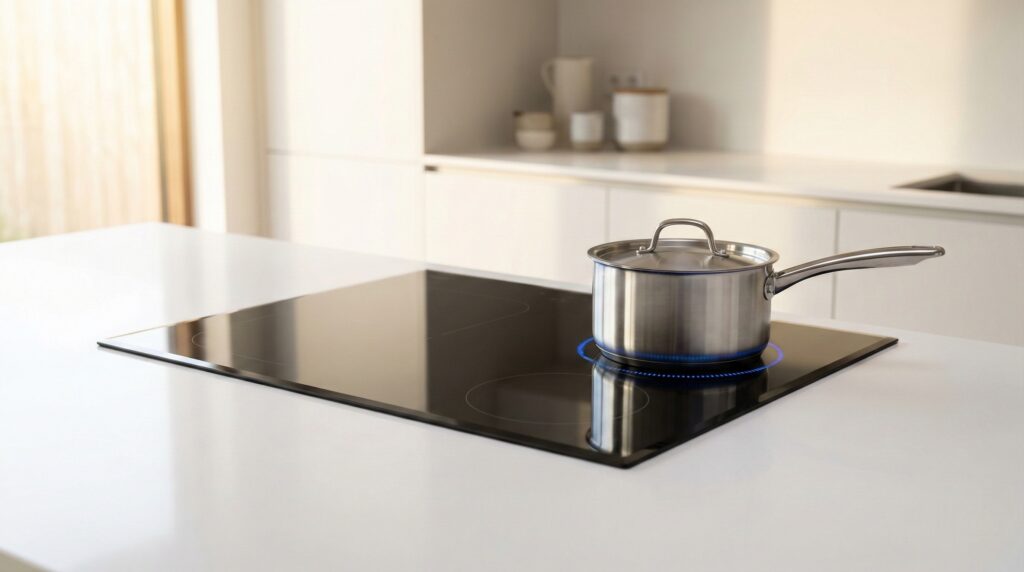
Understanding the science behind your stovetop can save you a lot of frustration in the kitchen. Unlike traditional gas or electric radiant stoves, which use thermal conduction to transfer heat from a burner to a pan, induction relies on electromagnetism. Your cooktop contains copper coils that create an alternating magnetic field. When you place a pan made of “ferromagnetic” material on top, that field induces an electric current—and thus heat—directly within the metal of the pan itself.
This is why high-conductivity materials like pure aluminum or copper won’t work on their own; they aren’t magnetic enough to “talk” to the coils. Modern cookware solves this by using “cladding,” where layers of aluminum or copper are sandwiched between sheets of magnetic stainless steel. Choosing the right home appliances is only half the battle; the pan is the second half of the circuit. If the pan is too thin, the intense magnetic force can cause it to vibrate rapidly against the glass, creating an annoying buzzing or whistling sound. Thicker, high-quality bases help dampen this vibration and ensure more uniform heat distribution.
Demeyere Atlantis & 5-Ply
Demeyere is often cited as the pinnacle of induction engineering. While most brands focus on making pans that “work” on induction, Demeyere designs theirs specifically to maximize the technology. Their Atlantis and 5-Ply lines feature a unique “TriplInduc” technology, which the brand claims makes the pans up to 30% more efficient on induction hobs compared to standard clad cookware. In practice, this means your water boils faster and your pan responds more instantly to temperature adjustments.
One of the standout features of Demeyere is the complete absence of internal rivets. Most pans have rivets holding the handles in place, which eventually collect grease and carbonized food. Demeyere welds their handles, leaving a perfectly smooth interior that is much easier to clean. For those moving from gas, you’ll notice the Atlantis line has a substantial weight that prevents it from sliding around on the glass surface. This stability is a key reason many professional chefs prefer it when they make the switch to electric kitchens. If you are looking for the best cookware for induction cooktop setups, Demeyere is the benchmark.
✅ What Users Love
- Rivet-Free Interior: Makes cleaning effortless and improves hygiene.
- Silvinox Finish: A proprietary treatment that keeps the stainless steel looking silvery-white even after years of high-heat use.
- InductoSeal Base: A seven-layer base with a copper core that ensures heat reaches the very edges of the pan.
- Stability: The heavy base prevents the “induction dance” where lighter pans vibrate or move across the glass.
❌ Watch Out For
- Weight: These are extremely heavy pans; some users with wrist issues find the larger pieces difficult to maneuver.
- Price: It is among the most expensive cookware on the market.
- Wait Times: Due to their popularity and manufacturing process in Belgium, specific pieces can sometimes go out of stock for months.
💼 The Verdict: Best for serious home chefs who want professional-grade performance and are tired of scrubbing around rivets. Skip if you prefer lightweight pans or are on a strict budget.
Heritage Steel Fully Clad
If you value American manufacturing and want a pan that outperforms the big-box brands, Heritage Steel is a fantastic choice. Based in Clarksville, Tennessee, this family-owned company uses 316Ti stainless steel. The “Ti” stands for titanium, which makes the cooking surface more resistant to corrosion and pitting, especially when cooking acidic foods like tomato sauce or using salt. This is a significant upgrade over the standard 304 or 18/10 steel used by most competitors.
On induction, Heritage Steel pans heat very evenly because they are “fully clad,” meaning the aluminum core extends all the way up the sides of the pan, not just in a disc at the bottom. This helps prevent the scorching that can happen at the “corner” of the pan where the base meets the wall. Many users on Reddit have noted that they switched to Heritage Steel from more famous brands because the handles are more ergonomic and the price is significantly more reasonable for the quality provided. In practice, these pans feel nimble yet sturdy, hitting a “Goldilocks” weight that works for most cooks.
✅ What Users Love
- 316Ti Stainless Steel: Superior durability and food safety compared to standard steel.
- Ergonomic Handles: Stay-cool handles that are comfortable for both overhand and underhand grips.
- Value for Money: Offers “buy it for life” quality at a lower price point than Demeyere or premium European imports.
- Fast Response: Thin enough to respond quickly to induction power changes but thick enough to hold heat.
❌ Watch Out For
- Availability: Primarily available online or through specialty retailers; you won’t find these at your local department store.
- Limited Variety: They focus on the essentials, so you won’t find as many “niche” pan shapes as you might with larger brands.
💼 The Verdict: Best for shoppers who want a high-end, USA-made set with superior corrosion resistance. Skip if you need a 20-piece set with every specialty shape imaginable.
Fissler Profi Collection
The Fissler Profi Collection is the heavy-duty German answer to the induction challenge. While Heritage Steel focuses on full cladding, Fissler uses an incredibly thick “CookStar” disc base. There is a common misconception that disc-bottom pans are inferior to fully clad pans, but on induction, the opposite is often true. Because induction coils only heat the area they touch, a massive, thick disc of aluminum at the bottom acts as a heat reservoir, spreading the energy out before it hits your food.
This construction makes Fissler virtually immune to warping. If you’ve ever had a pan develop a “bowed” bottom that makes it spin on your glass cooktop, you’ll appreciate the Profi’s stability. The weight of these pans also makes them the quietest on this list; the mass of the base effectively kills the high-pitched “buzz” that induction hobs can produce at high power settings. It’s a tank of a pan that feels like it could survive a century of daily use.
✅ What Users Love
- Unrivaled Flatness: The base is designed to stay perfectly flat even under extreme temperature changes.
- Integrated Measuring Scale: Laser-etched markings inside the pots for easy liquid measurements.
- Quiet Operation: Heavy construction minimizes electromagnetic resonance (the buzz).
- Condensate-Plus Lid: The lids are heavy and shaped to let steam drip back into the food, keeping roasts moist.
❌ Watch Out For
- Aesthetics: The “Profi” look is very industrial and utilitarian; it may not suit every kitchen’s vibe.
- Side Heat: Because the aluminum is only in the base, the sides don’t heat up as much, which is great for soups but less ideal for reducing thick sauces quickly.
💼 The Verdict: Best for cooks who want the most stable, quietest pan possible and don’t mind a “commercial kitchen” look. Skip if you do a lot of stir-frying or toss-cooking where side-wall heat is required.
Le Creuset Signature Series
Enameled cast iron and induction are a match made in heaven. Induction offers incredible precision at low temperatures, which perfectly complements the thermal mass of a Le Creuset Dutch Oven. While stainless steel is great for searing and boiling, cast iron is the undisputed champion for braising, stewing, and baking bread. The iron is naturally magnetic, so it requires no special cladding to work on an induction surface.
Le Creuset is particularly recommended for induction because their bottoms are machined very smooth compared to budget cast iron brands like Lodge. This smoothness is vital for protecting your expensive glass cooktop from scratches. Furthermore, the enamel coating means you don’t have to worry about the “seasoning” of the pan interacting with the glass or getting messy. It’s an heirloom piece that bridges the gap between the stove and the dining table beautifully.
✅ What Users Love
- Thermal Retention: Holds heat longer than any other material, making it ideal for “low and slow” recipes.
- Glass-Friendly Base: Smoother finish than raw cast iron, reducing the risk of micro-scratches.
- Vibrant Colors: Dozens of enamel colors to match any kitchen decor.
- Versatility: Moves seamlessly from the induction hob to the oven to the table.
❌ Watch Out For
- Slow to React: Because it is so thick, it takes longer to heat up and longer to cool down than stainless steel.
- Maintenance: While dishwasher safe, hand-washing is highly recommended to keep the enamel from dulling over time.
- Weight: A large Dutch oven filled with stew can weigh over 20 pounds; be careful not to drop it on the glass.
💼 The Verdict: Best for slow-cooking enthusiasts who want a pan that lasts generations. Skip if you need lightning-fast temperature changes for delicate sauces.
Kuhn Rikon 4th Burner Pot
Many induction ranges have one small, high-efficiency “accent” burner that often goes unused because standard pans are too large for it. The Kuhn Rikon 4th Burner Pot is the specific solution for this. It is a tall, narrow pot with a 12-cup capacity that occupies a tiny footprint on your stove. Because it is made of induction-compatible stainless steel, it benefits from the rapid boiling speeds of the technology.
This pot often replaces a tea kettle for many induction users. It boils water faster than most electric kettles and includes a locking strainer lid, making it perfect for small batches of pasta, asparagus, or hard-boiled eggs. It’s a “secret weapon” that solves the problem of kitchen clutter by doing the work of three different tools. It’s also surprisingly affordable, often found for under $50, making it a great entry point into high-quality induction cookware.
✅ What Users Love
- Space Efficiency: Tall design uses vertical space, leaving plenty of room for larger pans on adjacent burners.
- Multi-Functional: Works as a kettle, a steamer (with the included basket), and a pasta pot.
- Locking Lid: Allows for safe, one-handed straining of hot liquids.
- Fast Boiling: The narrow diameter concentrates the induction energy for incredibly quick boils.
❌ Watch Out For
- Balance: Because it is tall and narrow, it can be slightly top-heavy if you use the steamer basket; just be mindful of where the handle is pointing.
- Cleaning: The narrow shape means you might need a bottle brush to get into the bottom corners if you scorch something.
💼 The Verdict: Best for small families, apartment dwellers, or anyone who wants to reclaim their small stove burner. Skip if you only cook large-format meals.
Other Notable Alternatives Worth Considering
While the picks above are our top choices, several other brands are frequently recommended by the “Rewired Home” community. All-Clad remains a solid choice, particularly their D3 and D5 lines, though some users find their handles uncomfortable. For those seeking the cutting edge, Hestan offers “NanoBond” technology which is incredibly scratch-resistant and highly conductive on induction. If you are shopping at a high-end retailer, the Williams-Sonoma Thermo-Clad line is a well-regarded alternative that balances weight and performance similarly to Heritage Steel. Finally, for budget-conscious cooks, a simple Lodge Cast Iron skillet is the cheapest way to get high-performance induction searing, provided you are careful not to slide it across the glass surface.
What Real Users Are Saying (Reddit Insights)
General Sentiment
Across communities like r/cookware and r/inductioncooking, the sentiment is overwhelmingly positive regarding the switch to induction, but with one major caveat: the cookware makes or breaks the experience. Users frequently report that they didn’t realize how much “noise” poor-quality pans could make until they used them on a high-powered induction hob. The general consensus is that investing in a few high-quality pieces (like a Demeyere skillet and a Fissler pot) is much better than buying a cheap 12-piece set where half the pans don’t heat evenly.
Top Complaints & Warnings
The most common frustration centers on “the buzz.” As one user noted:
“I bought a cheap ‘induction ready’ set from a big box store and the whistling on power boost was so loud I thought the stove was broken. I switched to a heavy Fissler pot and the sound completely vanished.” — r/inductioncooking
Another critical warning involves the mismatch between pan size and burner size. Many induction cooktops have “zones” marked with large circles, but the actual magnetic coil inside might be 2 or 3 inches smaller than that circle. If you use a thin pan that is significantly larger than the coil, you will end up with a hot ring in the center and cold edges. This is why the community emphasizes buying pans with thick, conductive cores (like copper or aluminum layers) to help “bridge” the gap between the coil and the pan’s edge.
Budget Tips & Value Picks
For those who spent their entire renovation budget on the best induction cooktop and need to save on pans, Reddit users suggest a “hybrid” approach. They recommend spending the most on your primary skillet (Demeyere) and your large Dutch oven (Le Creuset), while saving money by using standard cast iron for searing. Another tip is to check restaurant supply stores for “heavy-duty” induction-ready stainless steel, which lacks the brand-name polish but offers excellent thermal performance for a fraction of the cost.
Buyer’s Guide: 3 Things to Check Before You Buy
1. Magnet Size vs. Pan Size
Before you buy a 12-inch skillet, check your cooktop’s manual for the actual diameter of the induction coils. Most mid-range cooktops only have one large coil, while the others may be 6 or 7 inches. If you put a massive pan on a small coil, only the center will heat. If you must use a pan larger than the coil, ensure it has a thick aluminum or copper core to help spread that heat laterally. Thin, “impact-bonded” bases are the worst offenders here and will lead to scorched food in the center and raw food at the edges.
2. Clad vs. Disc-Bottom Construction
“Fully clad” means the layers of metal go all the way up the sides. This is great for sautéing and making sauces where you want the entire pan to be hot. “Disc-bottom” means there is a thick puck of metal only on the base. While disc-bottom is often looked down upon, on induction, a *high-quality* thick disc (like Fissler) can actually be superior for heat distribution because it provides more mass to soak up the intense energy from the coil. For pots used for liquids, disc-bottom is fine. For fry pans, full cladding is generally preferred.
3. Flatness and Surface Protection
Induction requires a flat surface for maximum efficiency. If a pan is even slightly warped, it won’t receive the magnetic field evenly. When shopping, place the pan on a perfectly flat surface and see if it wobbles or spins. To protect your glass top, look for pans with smooth, polished bottoms. If you are worried about scratches from heavy cast iron, some users use thin silicone “induction mats” between the pan and the glass. These are safe because the glass itself doesn’t get hot, but only do this with low-to-medium heat cooking to avoid melting the mat.
Best Induction Cookware by Category
Best for Heirloom Quality
If you want pans that your grandchildren will be using, the Fissler Profi Collection is the way to go. Its massive weight and industrial-grade construction make it nearly indestructible, and its ability to remain perfectly flat on induction hobs is legendary among enthusiasts. You can find these occasionally on sale, making them a high-value “buy it once” investment.
Best Made in the USA
Heritage Steel is the clear winner for those who want to support domestic manufacturing without sacrificing performance. Their use of 316Ti titanium-strengthened steel puts them in a league of their own for durability, and their small-batch approach ensures better quality control than the mass-market brands you see in big-box stores.
Best for Small Burners
The Kuhn Rikon 4th Burner Pot is the most practical addition you can make to a new induction setup. It takes advantage of the fastest-heating zones on your stove and handles all the small tasks that usually require a bulky pot or a separate electric kettle. It’s the specialty tool you didn’t know you needed until you have it.
Frequently Asked Questions
Is Demeyere cookware worth the high price tag for induction?
Yes, for most serious cooks, Demeyere Atlantis is worth the investment. Its “TriplInduc” technology makes it significantly more efficient on induction hobs, and the rivetless interior is a massive quality-of-life upgrade for cleaning. While expensive, these pans are built to last a lifetime and offer the most consistent heat distribution of any brand we’ve tested. If you are already investing in high-end heating and cooling solutions for your home efficiency, this cookware is the logical extension of that philosophy.
Why does my cookware make a buzzing sound on induction?
The buzzing sound is caused by the high-frequency vibration of the different metal layers within your pan as they react to the magnetic field. This is most common in lighter, cheaper pans or “impact-bonded” disc pans where the layers aren’t perfectly joined. Using heavier cookware like the Fissler Profi or Demeyere Atlantis can significantly reduce or even eliminate this noise, as the mass of the metal dampens the vibrations.
How do I check if my existing pans are induction compatible?
The simplest way is the “magnet test.” Grab a refrigerator magnet and hold it to the bottom of your pan. If the magnet sticks firmly, the pan is induction compatible. However, keep in mind that “compatible” doesn’t always mean “performs well.” Very thin pans may still warp or buzz. If you are looking to replace your old set, check our guide on the best pans for induction cooktop for more detailed specs.
What is the difference between clad and disc-bottom induction pans?
Clad cookware (like Heritage Steel) has layers of conductive metal throughout the entire body, heating both the bottom and the sides. Disc-bottom pans (like Fissler) have a thick plate of conductive metal only on the base. On induction, a high-quality disc-bottom can actually be better for preventing hot spots because the extra thickness helps distribute the concentrated energy from the coil across the entire base of the pan.
Can you use cast iron on an induction cooktop without scratching it?
Yes, but you must be careful. Never “slide” cast iron across the glass; always lift it to move it. Brands like Le Creuset have smoother enamel bases that are less abrasive than raw cast iron. You can also use a parchment paper sheet or a thin silicone induction mat between the pan and the glass to provide a protective barrier, as the magnetic field will pass right through them without any loss of efficiency.
Final Thoughts
Transitioning to an induction-ready kitchen is one of the smartest moves you can make for home efficiency and indoor air quality. However, the technology is only as good as the vessel you put on top of it. By choosing cookware with high thermal mass, superior magnetic properties, and flat bases, you ensure that your stove operates quietly and efficiently. Whether you opt for the industrial perfection of Demeyere or the American craftsmanship of Heritage Steel, your goal is to find pans that can handle the rapid energy transfer of induction without warping or “singing.” Investing in quality now means you won’t be replacing your set in a few years, making it the most sustainable choice for your rewired home.
Disclosure: We earn a small commission on qualifying purchases through our Amazon links, at no extra cost to you.