TL;DR
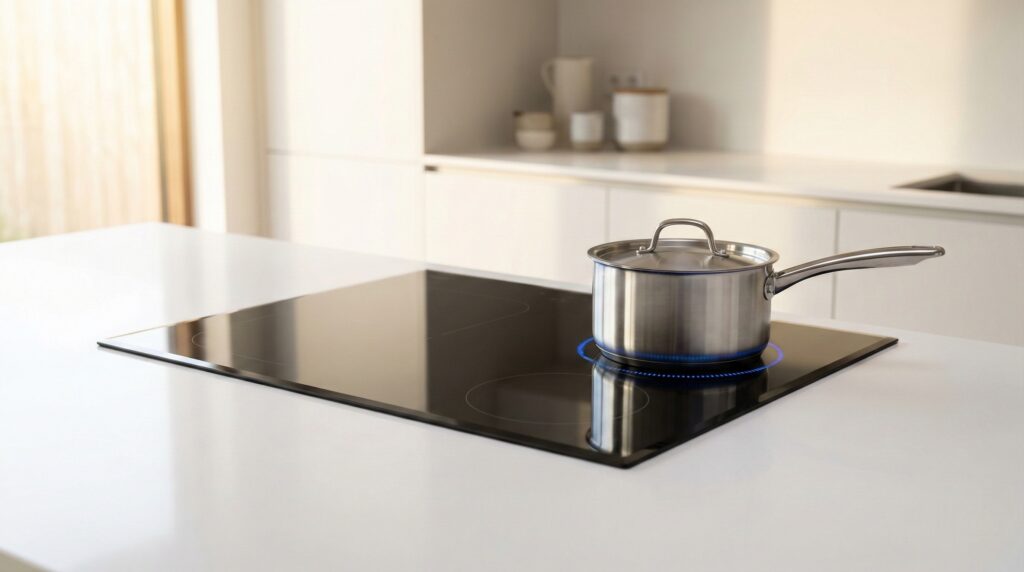
For most households, the right portable induction cooktop comes down to practical cooking behavior, not headline wattage. We’d prioritize a model with dependable power control, a heating area that works with your usual 10- to 12-inch pans, and a timer that won’t interrupt longer simmers — and that points most buyers to Duxtop as the safest all-around choice here.
Top Recommended Countertop Induction Cooktops
| Product | Best For | Price | Pros/Cons | Visit |
|---|---|---|---|---|
| Duxtop Portable Induction Cooktop, Countertop Burner | Best overall for most kitchens | Check price on Amazon | Strong everyday cooking feedback and broad appeal; some buyers report ring-size heating limits | Visit Amazon |
| Max Burton #6450 Digital LCD 1800 Watt Induction Cooktop | Best budget for basic cooking | Check price on Amazon | Affordable 1800W option with good real-cooking feedback; one-hour shutoff complaints matter for long cooks | Visit Amazon |
| Vollrath (59500P) Mirage Pro Countertop Induction Range | Best premium for serious cooks | Check price on Amazon | Commercial-grade build and premium positioning; very expensive and some temperature-control complaints appear | Visit Amazon |
Top Pick: Best Overall Countertop Induction Cooktops
Duxtop Portable Induction Cooktop, Countertop Burner
Best for: Most home cooks who want a dependable portable burner for weeknight cooking in a small apartment kitchen, as a backup burner during holidays, or in an RV setup with compatible magnetic cookware.
The Good
- Strong owner feedback for everyday countertop cooking
- Widely regarded as a solid value pick rather than a spec-sheet gimmick
- Useful for boiling, sautéing, and general meal prep on a standard household outlet
- Large enough following that buyer reviews reveal real-world quirks before you buy
- Portable induction format means fast heat response with magnetic cookware, as the U.S. Department of Energy explains
The Bad
- Some homeowner reports suggest the effective heating ring feels smaller than expected with wider pans
- Cookware compatibility complaints show up in buyer reviews
- Flat control layouts can still be less friendly than physical buttons when steam or splatter is involved
4.4/5 across 8,682 Amazon reviews
“Why did you pick this product vs others?:Let me start by saying I RARELY write a review. But after using this for 5 months, I felt compelled. In brief, all I have to say about this product is "Why did I wait so long to get one???" I love cooking – it is my happy place that takes me away from stresses of work (Bonus: you end up with good stuff to eat in the…” — Verified Amazon buyer (5 stars)
“After testing and using the this product here is my evaluation. Induction uses a coil that is wrapped with copper wire. In essence it is a ring with copper winding’s. The size of the ring will determine the size of the pan you can use on it successfully. THE BAD: The ring in this Duxtop is either 5 inches or if there is a 2nd outer ring it was defective.…” — Verified Amazon buyer (3 stars)
“now my current favorite: Duxtop 9600LS.” — r/KnowBeforeBuy discussion
One verified buyer summed up the long-term comfort level well: “Let me start by saying I RARELY write a review. But after using this for 5 months, I felt compelled.” — verified buyer, 5 stars
Our Take: This is the easiest recommendation for most people because it balances price, buyer confidence, and everyday usability better than the others. Research suggests that with portable induction, coil effectiveness and usable power control matter more than raw wattage because nearly every unit in this class is still limited by a standard 120V household circuit.
That matters in real cooking. For boiling water or heating a saucepan of soup, most decent induction burners feel quick. The bigger separator shows up when you move to a 10- or 12-inch skillet for eggs, searing, pancakes, or browning onions. Smaller active coils can overheat the center while leaving the outer edge behind, which is why consumer testing from Serious Eats and long-running customer experience alike keep pointing to pan fit as a major buying factor.
For this Duxtop, the upside is that it has enough owner history to show a consistent pattern: people generally like it for normal home cooking, but you should not expect edge-to-edge miracle heating with oversized cookware. One negative buyer quote captures that limitation directly: “The ring in this Duxtop is either 5 inches or if there is a 2nd outer ring it was defective.” — verified buyer, 3 stars
That does not knock it out of the top spot because every portable induction cooktop here faces some version of the same 120V constraint. What makes the Duxtop stand out is that it remains a practical, sane choice for actual kitchens. If you usually cook with medium saucepans, stockpots with a well-matched magnetic base, or 10-inch skillets rather than very wide pans, it should fit how most people really cook day to day.
It is also the pick we’d steer most buyers toward if they want a countertop unit for temporary use during a remodel or as a safer extra burner in a home where open flame is a concern. Induction itself transfers energy directly into the pan rather than heating an exposed electric coil, which is part of why the technology is often seen as both responsive and efficient. For broader appliance safety and electrical guidance, we still like to keep buyers anchored to the NFPA 70 National Electrical Code and to check the CPSC product recalls page before purchase if a model has been on the market a while.
If you are deciding between power settings and temperature presets, we’d lean toward power-based cooking for most tasks. Evidence indicates portable induction cooktops often behave more predictably in power mode than in temperature mode, especially for simmering sauces, oatmeal, or melting tasks where cycling behavior can affect results. For buyers who mainly want a reliable countertop burner without jumping to commercial pricing, this remains the strongest overall fit.
Max Burton #6450 Digital LCD 1800 Watt Induction Cooktop
Best for: Budget-minded buyers setting up a first induction burner for a condo kitchen, dorm-adjacent cooking space, or occasional holiday overflow station.
The Good
- Lower entry price than the top pick
- 1800W class output is in line with what most standard-outlet portable units can deliver
- Positive buyer feedback for real cooking use rather than novelty use
- Installer-style common sense says it can be a practical extra burner where a full cooktop is not possible
The Bad
- Reports of one-hour shutoff are a meaningful drawback for braising, stock, or long simmer tasks
- Smaller review depth means a little less confidence than the Duxtop
- As with most budget portable units, you should expect compromises in heating area and refinement
4.3/5 across 512 Amazon reviews
“This is our first induction burner and it worked perfectly for us! I know a lot of folks have asked if this unit can be used for pressure canners. We had the same question. My wife wanted to be able to can salmon while at our fishing locations, outside of our motorhome, not just after we returned home. But we didn’t want to use our pressure canner on open…” — Verified Amazon buyer (5 stars)
“This unit has a lot going for it – intuitive design, easy to clean, heats up quickly, has a very low "keep warm setting", but has two major flaws that make it unusable:It shuts off after an hour.This flaw, not mentioned in the user manual, shuts the unit down no matter what. I adjusted the temperature after what must have been 57 minutes of operation,…” — Verified Amazon buyer (1 stars)
“I use a Burton single induction burner all the time for braising.” — r/inductioncooking discussion
Our Take: If price is the main priority and your cooking is mostly boiling, sautéing, reheating, or short-to-medium sessions, this is the budget pick we’d consider first.
The key thing to understand is that “1800W” alone does not make this meaningfully stronger than other countertop induction cooktops on a normal 120V outlet. In practice, many units in this category cluster around similar peak power limits, so the bigger differences come from how the controls behave, how usable the lower settings are, and whether timer behavior gets in your way.
That is exactly where the Max Burton needs a caution label. The big red flag in customer experience is long-run shutoff behavior. One buyer reported: “It shuts off after an hour.This flaw, not mentioned in the user manual, shuts the unit down no matter what.” — verified buyer, 1 stars
For some households, that is a deal-breaker. If you make broth, braise short ribs, hold chili at a low bubble, or do any kind of batch cooking, an aggressive shutoff window can become more annoying than slightly uneven heating. On the other hand, if your portable burner mostly handles quick weekday tasks like pasta water, stir-fry prep, or warming a skillet while your main range is busy, that flaw may never matter much.
We also think this one makes sense for buyers who are induction-curious and want to test the format without spending much. Just pair it with cookware that has a flat magnetic base and keep expectations realistic with wider pans. A portable unit can absolutely be useful, but it will not behave like a full-size hardwired induction range. That distinction matters whether you are cooking in a studio apartment or using it as a backup during a kitchen renovation.
Vollrath (59500P) Mirage Pro Countertop Induction Range
Best for: Serious cooks outfitting a dedicated prep space, test kitchen, or heavy-use home setup where commercial-grade build quality matters more than price.
The Good
- Premium commercial-grade positioning
- Distinct step up from mainstream consumer units in intent and build class
- Appeals to buyers who want a more serious countertop induction platform
- Relevant if you are comparing consumer products with equipment that may also appear in foodservice discussions tied to NSF standards
The Bad
- Huge price jump over consumer-friendly models
- Some buyer reviews question temperature accuracy at low settings
- Hard to justify unless you know why you want commercial-adjacent gear
4/5 across 99 Amazon reviews
“I grew up cooking with natural gas and had a natural gas stove for twenty years in my own home before moving to a home without gas. After migrating from a coil burner range (horrible) to a ceramic range (tolerable) I was gifted a NuWave induction hob and bought some good quality tri-ply stainless/aluminum pans to use with it. I was very favorably impressed…” — Verified Amazon buyer (5 stars)
“Temperature control has a fatal flaw…in addition to a broken temperature sensor? Set on 150 degrees F, it finally "came to rest" around 197 degrees F. It took 35 minutes to get there! The iniital turn-on over shoot of temperature took the pan from 78 to 276 degrees F. It then descended slowly to just below the 200 degree mark. Clearly there is a…” — Verified Amazon buyer (1 stars)
“Also tested a buddy’s Vollrath Mirage Pro and the NuWave Pro Chef.” — r/KnowBeforeBuy discussion
“I was very favorably impressed with the NuWave but eventually wanted be” — verified buyer, 5 stars
Our Take: This is the premium niche pick, but only for buyers who are intentionally shopping above the usual consumer tier and can live with the high cost.
Vollrath is the outlier here because it plays in a different price bracket and a more commercial-feeling lane. That does not automatically make it the best performer for every home kitchen. In fact, one of the recurring truths with induction cooktops is that premium positioning does not erase the need for sane control behavior and cookware matching.
That is why we would not recommend this model just because it sounds professional. One homeowner report was blunt about the low-temperature issue: “Set on 150 degrees F, it finally “came to rest” around 197 degrees F.” — verified buyer, 1 stars
If precision at the low end is your whole reason for spending up, that kind of feedback should give you pause. Still, for buyers who cook heavily, want a more robust countertop unit, and understand that commercial-grade style is not the same as magic performance, it can make sense as a premium alternative.
This is also where broader context helps. NSF standards can matter if you are comparing home models with foodservice-adjacent equipment, but certification and commercial branding alone do not settle everyday home usability. We’d still judge this one by the same core questions: how it handles your pan sizes, how stable the lower heat levels feel, and whether the controls support the way you cook. If your use case is a serious home prep station with frequent repeat use, the Mirage Pro is the one premium option here worth a look.
FAQ
What size pan works best on a portable induction cooktop?
In most cases, medium-size cookware with a flat magnetic base works best. The main thing is not the pan’s top diameter but the diameter of the base that actually touches the cooking surface. Portable induction units tend to have a smaller active heating area than full-size ranges, so a very wide 12-inch skillet may heat strongly in the center and less evenly at the edges if the coil underneath is relatively small.
Is 1800W enough for serious cooking?
Yes, within limits. An 1800W portable induction cooktop is enough for boiling water, sautéing, pan-frying, and many everyday cooking jobs, but it is still limited by a standard 120V household circuit. That means even the strongest countertop units are not a substitute for a full-size induction range when you are trying to deep-fry large batches, heat oversized stockpots fast, or get perfect edge-to-edge performance in very large pans.
Should I use power settings or temperature settings?
For most home cooking, we’d use power settings first. Research suggests power modes are usually more predictable on portable induction burners because many temperature presets rely on sensor logic and cycling behavior that can feel inconsistent in real pans with real food. For boiling, frying, and simmering, consistent power steps often give you better repeatability than a preset temperature number.
Why do some portable induction cooktops heat the center more than the edges?
The biggest reason is coil size. If the active induction coil under the glass is small relative to the base of your pan, the center of the cookware gets more direct energy than the outer area. That can lead to hot spots, scorching in the middle, or weak simmering around the edge. This is one of the main reasons we tell buyers to care more about effective heating area than flashy marketing language.
How long can a countertop induction cooktop run before auto shutoff?
That varies a lot by model, and it matters more than many buyers expect. Some units can handle long cooking sessions reasonably well, while others have stricter timer or auto-shutoff behavior that may interrupt braises, broth, or long simmers. If you regularly cook for more than an hour unattended, check timer limits closely and pay attention to customer experience around unexpected shutdowns.
Are fan hum and whining noises normal on induction cooktops?
Usually, yes. Portable induction cooktops often use internal cooling fans, and some also produce coil-related sounds depending on the pan and power level. A soft hum or intermittent fan noise is common. What matters is whether the noise becomes annoying in your space, especially in a small kitchen, dorm, or open-plan apartment where the cooktop may be used close to where people sit or sleep.
Do I need special cookware for a countertop induction burner?
Yes — the cookware must be magnetic. Cast iron and many stainless steel pans work, while aluminum, copper, and glass only work if they have an induction-compatible magnetic base. A simple magnet test helps: if a magnet sticks firmly to the bottom of the pan, it will usually work on induction. Matching the pan base size to the burner’s active area matters almost as much as compatibility itself.
Are portable induction cooktops safe on regular kitchen outlets?
Generally yes, as long as you use them as directed on a suitable household circuit and avoid sketchy extension-cord setups. They are designed for standard outlets, but high-draw appliances still deserve common-sense electrical care. For general household wiring and branch-circuit safety, the NFPA 70 National Electrical Code is the core reference. If you have older wiring, nuisance breaker trips, or outlet heat, it is smart to ask a licensed electrician to look things over.
Bottom Line
The Duxtop Portable Induction Cooktop, Countertop Burner is still our top recommendation for most buyers because it best balances price, owner confidence, and everyday cooking usefulness. If you cook with medium-size magnetic pans and want a dependable portable burner for normal home tasks, it is the safest all-around pick. Spend down to the Max Burton if budget matters most, or up to the Vollrath only if you specifically want a premium commercial-style countertop unit.
Affiliate disclosure: We may earn affiliate commissions from qualifying purchases. This doesn't influence our reviews.