TL;DR
“Apartments with EV charging” range from true, dedicated overnight charging at your assigned space to a couple of shared chargers that are often full. If you want EV life to feel easy, prioritize buildings where you can reliably plug in overnight (ideally Level 2), with clear access rules and predictable pricing.
What Apartments With EV Charging Actually Is
“Apartments with EV charging” is a catch-all phrase, and it helps to translate the marketing into the three setups you’ll actually encounter:
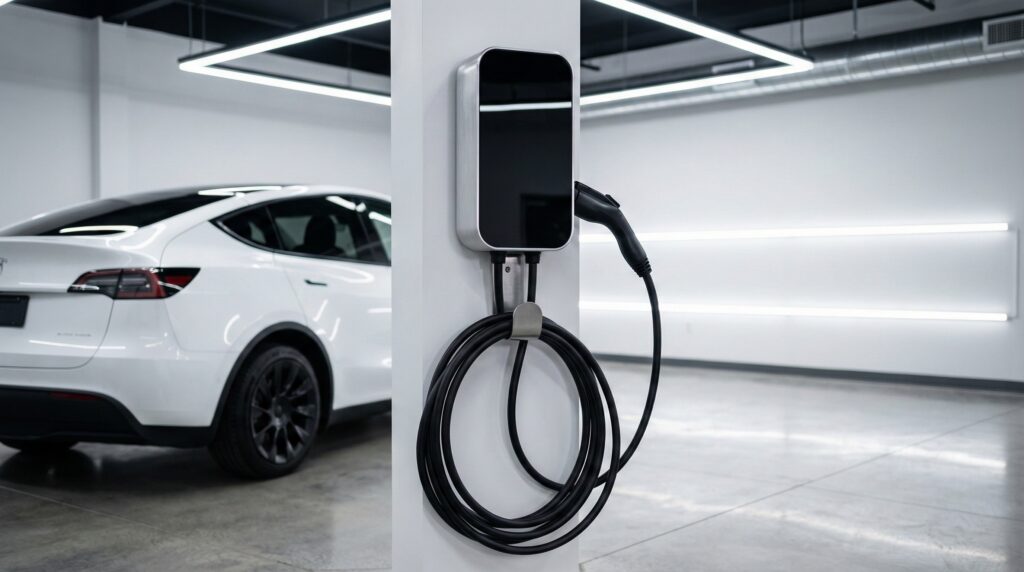
- Dedicated charging at your assigned spot: The best-case scenario. You have an assigned parking stall and either a dedicated Level 2 EV charger (EVSE) installed there, or the building allows (and has a process for) installing one. For day-to-day life, this is closest to “charging at home.”
- Shared charging in a garage/lot: The building provides a small number of chargers for many residents (and sometimes the public). This can work well if there are enough ports for the number of EV drivers, if access is resident-controlled, and if enforcement prevents non-charging cars from blocking the spots.
- “EV-ready” or standard outlet access (Level 1): Sometimes “EV-ready” means conduit and spare electrical capacity, not an actual charger you can use today. In other cases, a 120V outlet may be available near a parking space. Level 1 can be workable if you can stay plugged in for long periods (typically overnight, many hours), but it’s much slower than Level 2.
From a practicality standpoint, the question isn’t “does the building have EV charging?” It’s:
- Is charging access reliable? (Can you actually count on plugging in when you need to?)
- Is it fast enough for your weekly driving? (Level 2 is typically the difference between “overnight refill” and “constant planning.”)
- Is it priced fairly and transparently? (Per kWh pricing is usually the easiest to understand; time-based pricing can be fine but may include idle fees.)
Charger terminology matters. The U.S. Department of Energy’s charging overview is a good baseline for what Level 1, Level 2, and DC fast charging mean in the real world and why they differ in speed and use case; see the U.S. Department of Energy Alternative Fuels Data Center charging guide. On the connector side, many apartment AC chargers use the J1772 standard (and many vehicles can use adapters when needed); that’s governed by SAE J1772 (SAE International).
Finally, remember that a multi-unit building is a shared electrical environment. Any new EVSE installation (especially Level 2) should be designed and installed to code — Article 625 in the National Electrical Code (NFPA 70) is the core reference most electricians will follow for EV charging equipment and circuits. If the building is proposing an install (or letting tenants install), you want a licensed electrician (NEC-familiar) involved, not a “handyman special.”
Who Apartments With EV Charging Fits Best
This kind of apartment setup is most worth prioritizing when it meaningfully reduces friction in your week — because if charging becomes a routine errand, EV ownership can feel harder than it needs to.
Apartment EV charging tends to fit best for:
- Drivers who can charge overnight (or for long blocks), even if the charger is shared — because the best “fueling” routine is the one you do while you sleep.
- Commuters who can’t rely on workplace charging and don’t want to plan their week around public DC fast charging stops.
- Cold- or hot-climate drivers where efficiency swings can increase energy use and make slow charging feel more limiting.
- Residents with an assigned space (or a building with a strong reservation/enforcement system), since “floating parking” can turn charging into a daily competition.
- People willing to ask detailed questions before signing—number of ports, access rules, pricing model, enforcement, and whether chargers are resident-only.
If you’re evaluating a building that’s truly serious about resident charging, you’ll often see the same hardware brands come up. In customer experience with one popular home-facing unit (used in condos and some multi-family installs), homeowners highlight ease-of-use when things go smoothly — for example: “Works great with our Tesla.” — buyer review, 5 stars.
Who Should Skip Apartments With EV Charging
Not every “EV charging available” listing is worth paying extra for. In some buildings, the charging amenity is mostly a leasing-office talking point: too few ports, too many EVs, unreliable maintenance, or pricing that’s hard to justify.
You should be cautious — or skip — if:
- The building won’t put rules in writing (who can use the chargers, how long you can stay, what happens when a car is blocking a spot, towing policy, guest access).
- There are very few ports relative to likely demand, and management won’t share utilization or waitlist info.
- Access is shared with the public (retail/public garage access) and there’s no resident priority, especially in busy areas.
- Pricing is time-based without clear idle-fee explanations, making it easy to rack up surprise charges if you can’t move your car quickly.
- The building only offers a standard outlet solution but doesn’t allow overnight plugging, doesn’t enforce cord safety, or the outlet/circuit situation seems questionable.
Also, even reputable charging brands get criticism around setup and account configuration. One critical customer report reads: “Very difficult to connect to Wi-Fi and set up.” — buyer review, 1 stars.
If you’re already feeling red flags during the tour — vague answers, broken stations, unclear signage, cars parked in EV spots with no enforcement — it usually doesn’t get better after you sign.
Price and Value
Apartment EV charging costs are tricky because you’re often paying in multiple ways at once:
- Rent premium (properties advertise EV charging and price accordingly).
- Parking premium (assigned garage spaces, reserved EV spaces, or “premium” stalls can be an add-on).
- Charging fees (per kWh, per hour, per session, plus possible idle fees).
As a reality check, an at-home Level 2 charger unit itself often lands in the mid-hundreds before installation. For example, the ChargePoint Home Flex is commonly listed around $450–$500 for the unit alone (installation and permitting are separate and can vary widely by building layout, distance to power, panel capacity, and whether trenching/conduit is required).
When paying extra can be worth it: if the building’s setup reliably replaces most of your public charging. Even if the rent is a bit higher, predictable overnight charging can save time and reduce the need to rely on DC fast charging for routine weekly energy needs.
When it’s not worth it: if you’re paying a premium but still have to fight for a charger, move your car mid-session due to rules, or end up fast-charging anyway because shared Level 2 stations are always occupied.
If you’re comparing buildings, ask management to show you exactly how billing works (per kWh vs time-based). Per kWh is usually the easiest to compare to home electricity rates; time-based billing requires you to understand the station’s actual power delivery and any idle fees.
Common Mistakes When Trying Apartments With EV Charging
Most “apartment EV charging” problems aren’t about the car — they’re about mismatched expectations, unclear policies, and not verifying how charging works day-to-day.
- Assuming “EV-ready” means “charger installed.” Ask whether there is active, usable EVSE today, where it is, and how many ports are live.
- Not counting ports vs real demand. Two chargers for a 300-unit building might be fine today (if almost no one has EVs) or completely unusable (if adoption is already high). Ask about utilization, waitlists, and whether expansion is planned.
- Ignoring access control and enforcement. You want to know: Do you need an app/RFID? Is it resident-only? Do they tow ICE vehicles blocking EV spots? Are there time limits?
- Not asking about charging speed. “Level 2” is not automatically “fast.” Some systems are load-managed or power-shared and can deliver less power at peak times. Ask what amperage/kW you should expect and whether power is shared across ports.
- Overestimating Level 1 practicality. A 120V outlet can work for low daily miles if you can be plugged in for long stretches and the outlet/circuit is in good shape. If you can only plug in for a couple hours at a time, Level 1 often turns into constant planning.
- Using improvised extension cords as a “plan.” This is a common temptation in older garages. It’s also a common way to create overheating risk. If you must use Level 1, get explicit written permission and make sure the outlet/circuit approach is safe and compliant; when in doubt, have a licensed electrician evaluate it.
Setup friction can also be a real pain point with networked chargers (apps, Wi-Fi, accounts). One homeowner report that captures this risk: “The app is clunky and the setup was painful.” — buyer review, 2 stars.
For any building promising a new install or an expansion “soon,” get the timeline and decision-maker in writing. Vague promises don’t charge your car.
FAQ
What questions should I ask on a tour to verify EV charging is actually usable?
Ask: How many total ports are installed and how many are currently operational? Are chargers resident-only or open to the public? Is there an assigned EV stall option? How is access managed (app/RFID/fob)? What is the pricing model (per kWh vs per hour, session fees, idle fees)? What happens when a car blocks an EV space, and is towing enforced? Also ask where the chargers are relative to your likely parking spot and whether cables comfortably reach typical charge-port locations.
Is Level 1 charging enough at an apartment?
Sometimes. Level 1 (120V) can be workable if you have modest daily miles and can stay plugged in overnight for long stretches. If you have a longer commute, irregular hours, or can’t reliably park near the outlet, Level 1 often becomes inconvenient fast. For an overview of charging levels and what they’re used for, reference the U.S. Department of Energy Alternative Fuels Data Center charging guide.
How do shared apartment chargers work in practice?
It varies by building. Some operate first-come, first-served; others use reservations; many require activation through a network app. What matters is enforcement: whether non-EVs are kept out, whether cars that finish charging have to move, and whether idle fees are used (and clearly communicated) to keep stalls turning over. Before signing a lease, get the key rules in writing so you’re not relying on “community etiquette” to fuel your car.
If an apartment advertises “EV-ready,” what proof should I request?
Ask whether EV-ready means (1) an installed charger you can use now, (2) a dedicated circuit/outlet at your stall, or (3) only “future capacity” like conduit and spare electrical room space. Request specifics: location, number of live ports, whether your stall is eligible, and whether there’s an established process for adding EVSE (approved contractor list, permits, billing method, and timeline).
Can I install my own Level 2 charger in an apartment or condo parking space?
Sometimes, but it depends on whether your parking is assigned/deeded, the building’s electrical capacity, and property rules (management/HOA). You’ll typically need written approval, a permit, and a licensed electrician to design and install it to code. EVSE installations are generally governed by National Electrical Code requirements; electricians often reference EV-specific requirements in NEC Article 625 (NFPA 70).
What connector type should I expect at an apartment charger?
Many AC Level 2 stations in the U.S. use the J1772 connector, and many vehicles can use adapters when needed. Tesla drivers may need to confirm whether the station is J1772 (with an adapter) or NACS-native. If you want the standards reference for J1772, see SAE J1772 (SAE International).
What’s a reasonable charger-to-EV ratio in an apartment building?
There isn’t a single magic number because it depends on resident driving patterns, whether charging is overnight, and whether the building enforces turnover. The practical test is: can you reliably get the energy you need each week without adding constant “charger hunting” to your routine? During your tour, look for signs of scarcity (cars waiting, chargers blocked, signage pleading for etiquette) and ask management whether there’s a waitlist and how quickly issues are repaired.
Looking for these on Amazon? Browse apartments with ev charging on Amazon →
Bottom Line
Apartments with EV charging are worth prioritizing when they provide reliable, repeatable overnight access—ideally Level 2 at an assigned or well-managed space — with clear rules and transparent pricing. If the building can’t show you how charging works in practice (ports, access control, enforcement, and costs), assume the convenience may be overstated and choose only if nearby fast charging truly fits your lifestyle.
Affiliate disclosure: We may earn affiliate commissions from qualifying purchases. This doesn't influence our reviews.