TL;DR
For most induction kitchens, the safest “do-it-all” choice is cookware with a strongly magnetic, reliably flat base — and construction that spreads heat evenly so you don’t fight hot spots. We generally like fully-clad (tri-ply) stainless for everyday cooking, then adding one induction-rated nonstick pan (used on low-to-medium heat) if you want easy eggs and fish.
Top Recommended Induction Cookware
| Product | Best For | Price | Pros/Cons | Visit |
|---|---|---|---|---|
| Hestan ProBond Forged TITUM Cookware Set | Induction-friendly nonstick set with better browning | Check price on Amazon | Homeowner reports praise searing for nonstick; durability and warranty experience is mixed | Visit Amazon |
| All-Clad D3 Stainless Steel 10 Piece Cookware Set | Everyday stainless set for most induction cooktops | Check price on Amazon | Well-known clad stainless performance; pricing is on the high side for a full set | Visit Amazon |
Top Pick: Best Overall Induction Cookware
All-Clad D3 Stainless Steel 10 Piece Cookware Set
Best for: A typical U.S. home kitchen with a 30-inch induction range, where you want one stainless set that can simmer, sauté, and boil without babying the pans.
The Good
- Fully-clad stainless is the “default best bet” for induction because it tends to be strongly magnetic at the base and more even-heating than thin stainless.
- Responsive temperature control: when you turn induction power up or down, clad stainless generally follows quickly, which helps with sauces and sautéing.
- Good day-to-day durability for a set you’ll keep for years (handles, rims, and interiors tend to hold up better than bargain stainless).
- Set format covers the basics for most households, so you can match pot/pan size to each induction element instead of forcing one oversized pan on every burner.
The Bad
- Expensive for a full set — and you may not need every piece if you mostly cook for one or two people.
- Stainless has a learning curve (preheating, oil timing) compared with nonstick, especially on induction where heat ramps fast.
- As with any induction setup, performance depends on matching pan base diameter to your cooktop’s element size to prevent cycling or edge underheating.
4.6/5 across 1,791 Amazon reviews
“This All-Clad Cookware Set is an outstanding choice for anyone that loves to cook. This set is awesome, and offers exceptional durability due to its construction. They have a quick and even heat distribution, which significantly improves cooking performance for things like searing and browning.Being able handle temperatures up to 600°F, makes them suitable…” — Verified Amazon buyer (5 stars)
“I had high hopes for this sauté pan, but my experience has been extremely disappointing. After just four uses, the pan has warped significantly, rendering it unusable. I followed all the care instructions diligently, but still encountered this issue. I expected better quality, especially for the price. Unfortunately, I cannot recommend this pan based on my…” — Verified Amazon buyer (1 stars)
Our Take: If you want one long-term induction foundation, a clad stainless set like this is the most broadly useful starting point — then add specialty pieces (nonstick, cast iron) only if your cooking habits justify them.
Hestan ProBond Forged TITUM Cookware Set
Best for: Households that cook a lot of delicate, sticky foods on induction (eggs, fish, reheats) but still want better browning than typical nonstick — especially on a glass-top induction range where easy cleanup matters.
The Good
- Induction-compatible nonstick set, so you’re not guessing whether the cooktop will “see” the pan.
- Homeowner reports specifically praise searing and browning performance that’s uncommon for nonstick cookware.
- Convenient for fast weeknight cooking when induction’s quick ramp-up can otherwise make stainless feel fiddly.
- Buyer reviews mention a PFOA-free claim (as stated in customer experience), which may matter if you’re trying to reduce certain chemicals in your kitchen.
The Bad
- Lower buyer-review volume than long-established stainless sets, so there’s less long-run consensus on lifespan.
- Durability complaints show up in customer experience, including concerns about delamination.
- Like most nonstick, it’s not the best tool for high-heat induction cooking — overheating (or preheating empty) can shorten coating life and increase warping risk.
4.3/5 across 20 Amazon reviews
“Best pots and pans I’ve ever had. Even heat distribution. Pretty non-stick without the non-stick poisons.” — Verified Amazon buyer (5 stars)
“Cookware is delaminating in only a year’s worth of modest use and Hestan ghosted me when I requested that they live up to their warranty and provide a replacement.” — Verified Amazon buyer (1 stars)
“Personally getting induction a decade kicked off my love for my now extensive Le Creuset collection. As far as stainless I’ve had all clad, Hestan, Demereye (the 5 ply not Atlantis), Williams-Sonoma thermoclad.” — r/cookware discussion
“Most nonstick pans I have used have been disappointing when cooking meat. Not this pan. You can actually get a good sear and color in your steaks and chops.” — verified buyer, 5 stars
Our Take: If you want a nonstick-forward induction set and you’ll keep heat disciplined (low-to-medium, no empty preheats), this is one of the few options where homeowner reports call out legit browning — but we’d go in with eyes open about mixed durability feedback.
FAQ
How can I tell if cookware works on an induction cooktop?
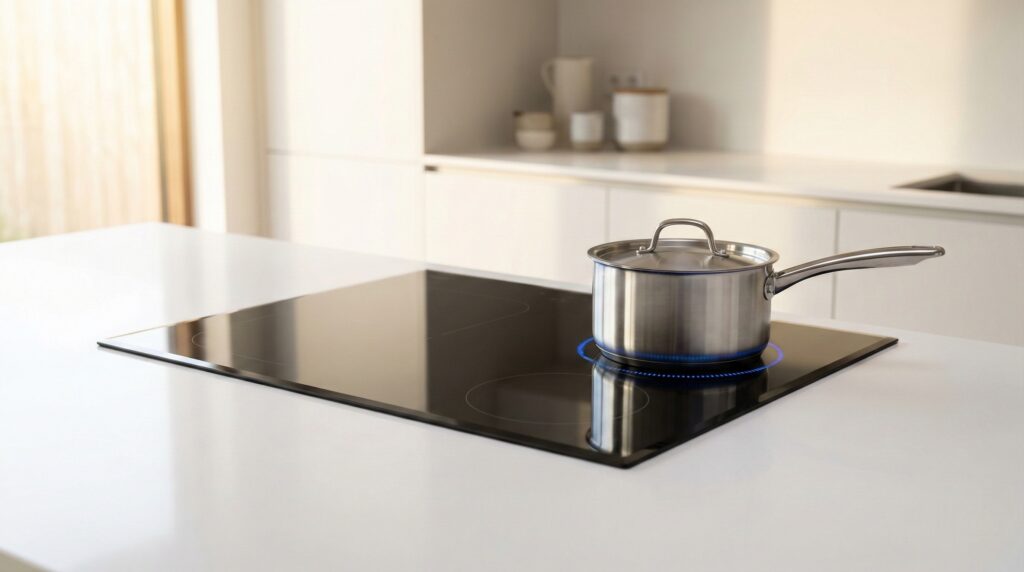
A magnet should stick strongly to the bottom of the pan. Induction works by creating a magnetic field that heats ferromagnetic cookware (not the glass surface), so weak magnetism can mean poor performance or a burner that won’t activate. For a plain-English overview of how induction cooking works, see the U.S. Department of Energy’s induction cooktop guide.
Why does my induction burner cycle on and off with some pans?
The most common causes are (1) the pan’s magnetic base is too small for that element, (2) the base isn’t very magnetic, or (3) the bottom isn’t flat, so the cooktop’s sensors don’t see consistent contact. In practice, this shows up a lot when you use a small saucepan on a large “burner ring,” or when a pan is slightly warped and rocks on the glass.
Is fully-clad stainless better than disc-bottom stainless on induction?
Often, yes — clad stainless tends to spread heat more evenly up the sides and responds faster to power changes, which is helpful for sautéing and sauce work. Disc-bottom stainless can still be a good value for boiling and steady simmering, but performance varies depending on how thick and wide the base disc is and how flat it stays over time. If you’re curious why some stainless is magnetic and some isn’t, the American Iron and Steel Institute (AISI) has background on stainless types and composition.
Can I use nonstick on induction safely?
Yes — as long as it’s induction-compatible (magnetic base) and you treat it like nonstick: avoid high heat, don’t preheat empty, and don’t try to get cast-iron-style sears at max power. Induction can heat very quickly, so a pan can run hotter than you expect if you’re used to gas or standard electric coils.
What pan sizes work best on most induction ranges?
In many kitchens, a 10–12-inch skillet, a 3–4-quart sauté pan (or “everyday pan”), and a 2–3-quart saucepan cover most meals. The key detail is base diameter, not the labeled top diameter — you want the flat bottom to roughly match the induction element you’ll use most to reduce cycling and edge underheating.
What should I check if I plan to finish dishes in the oven?
Look up the line’s oven-safe limits for the handles and lids (glass lids and some knobs cap out at lower temperatures). If the manufacturer doesn’t clearly state an oven-safe temperature, treat that as a reason to choose a different line — especially if you often go from stovetop to broiler or a hot bake.
Do induction cooktops require special cookware care?
The main “special” care is about protecting the cooktop surface and keeping pan bottoms flat. Keep the underside clean (burnt-on oil can scratch), avoid sliding heavy pans aggressively, and don’t thermal-shock hot cookware with cold water — that’s one of the easier ways to encourage warping over time.
Bottom Line
For most people, the best induction cookware foundation is fully-clad stainless for daily cooking, plus one induction-rated nonstick pan if you want easy release for eggs and fish. From our picks, the All-Clad D3 Stainless Steel 10 Piece Cookware Set is the best overall starting point because clad stainless is a reliable match for induction’s fast, sensor-driven heating.
Affiliate disclosure: We may earn affiliate commissions from qualifying purchases. This doesn't influence our reviews.